
Food-Grade and Medical-Grade LSR
Many dispensing and medical access valves use silicone or LSR in the 30 to 40 Shore A range to balance easy opening with reliable elastic closure.
Self-sealing silicone rubber dispensing valves for controlled flow, drip prevention, access ports, and repeatable open-close performance.
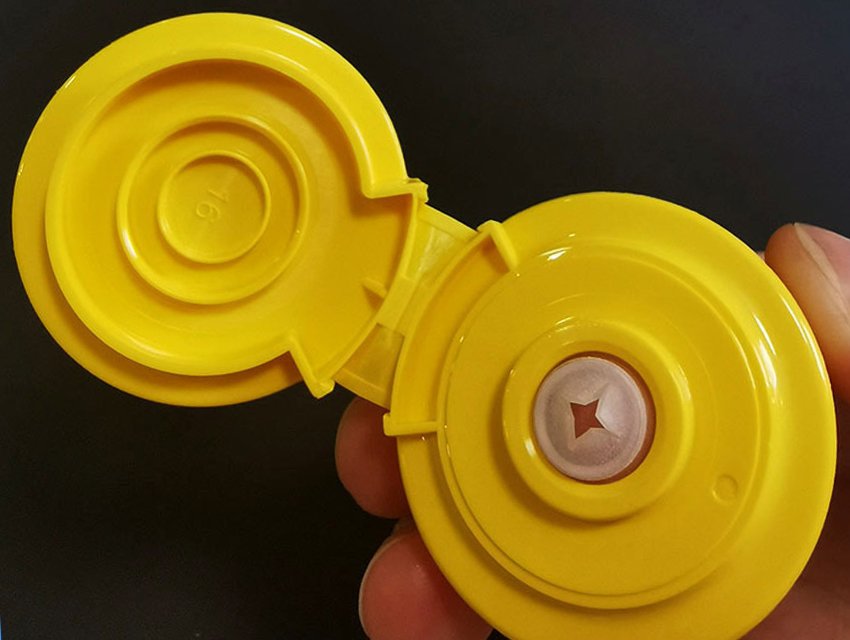
A cross-slit valve is a self-closing flow-control valve made by cutting intersecting slits into a flexible elastomer diaphragm. The diaphragm is usually a flat or dome-shaped silicone membrane.
At rest, the elastic cusps remain in contact and close the opening. Applied pressure, squeezing, or instrument insertion opens the slit. When the load is removed, the cusps recover and close again. Compared with a narrow linear duckbill slit, a cross-slit design can provide a larger instant flow opening and can also be designed for dispensing or access functions.
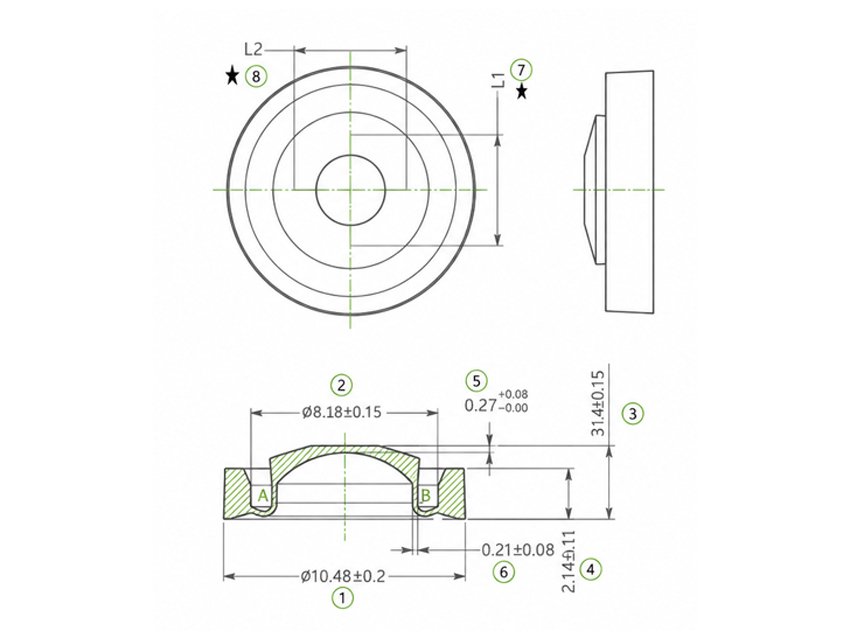
Material stiffness determines how much force opens the slit, while elastic recovery helps it close again. The selected compound must also resist tearing and remain compatible with the fluid and any sterilization process.

Many dispensing and medical access valves use silicone or LSR in the 30 to 40 Shore A range to balance easy opening with reliable elastic closure.
Alternative elastomers can be selected when oil resistance, weather resistance, chemical resistance, or other application-specific properties are more important.
Silicone valves can be manufactured by compression molding and LSR injection molding, depending on the product structure and quantity. The manufacturing process of silicone cross-slit valves requires precision and expertise to ensure the quality and reliability.
The valve relies on elastomer recovery to keep the slit closed until pressure or mechanical insertion forces the cusps apart.
The slit edges remain in contact under normal conditions, blocking fluid flow and helping isolate the inside of the system from outside contamination.
Squeezing a container or applying sufficient pressure pushes the cusps outward and creates a larger temporary flow opening.
When pressure is released or an instrument is removed, the silicone recovers and the slit edges return to contact.
Cross-slit valves are generally made in two stages. First, LSR injection molding or silicone compression molding forms the flat or dome-shaped diaphragm. Precision cutting or punching then creates the slit pattern in the membrane.
The slit must open evenly and reseal without damage. We control the cut position and tool condition against the valve's wall thickness. Where sticking is a concern, the specified surface treatment is also checked during validation.
Liquid or high-consistency silicone is conditioned and precisely metered by weight into charge preforms. Charge accuracy helps control diaphragm thickness, flash, and short-shots near the slit zone.
Liquid injection or compression molding at 150-180°C forms the flat or dome diaphragm and mounting features. Membrane thickness sets opening force and sealing recovery.
A secondary thermal cure drives off cure byproducts and stabilizes extractables, supporting downstream ISO 10993 biocompatibility testing when required.
Cross, X-slit, Y-slit, star-shape, or custom patterns are cut or punched with aligned tools. Flash is removed without nicking the self-sealing cusps.
Every unit is tested for forward opening force and reverse-seal integrity against your spec window before it leaves the line.
Parts can be ultrasonically cleaned and packaged under ISO Class 8 cleanroom controls, also described as Class 100,000 cleanroom conditions, before your EtO or gamma sterilization cycle.
Production samples, molded diaphragm control, precision slitting, and cleanroom packaging examples for custom cross-slit valve programs.
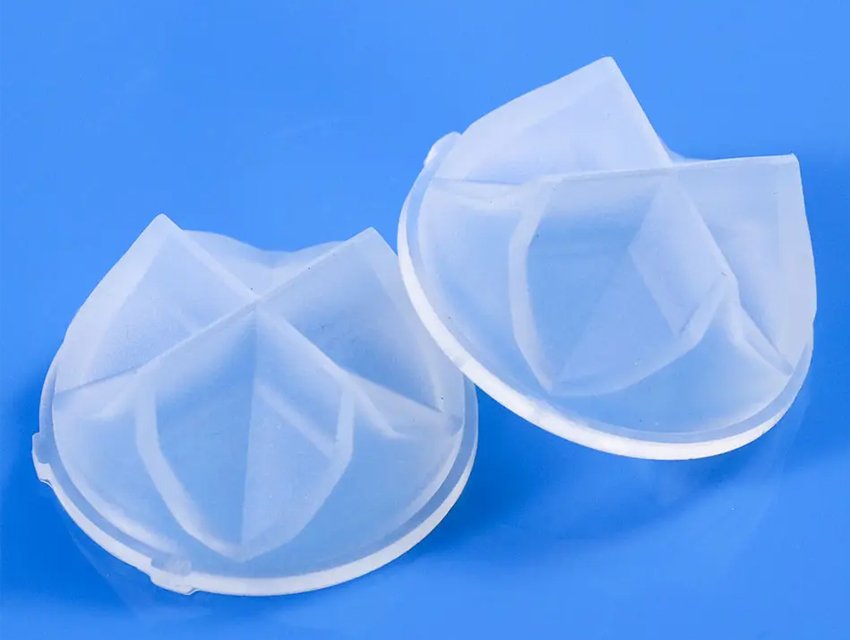
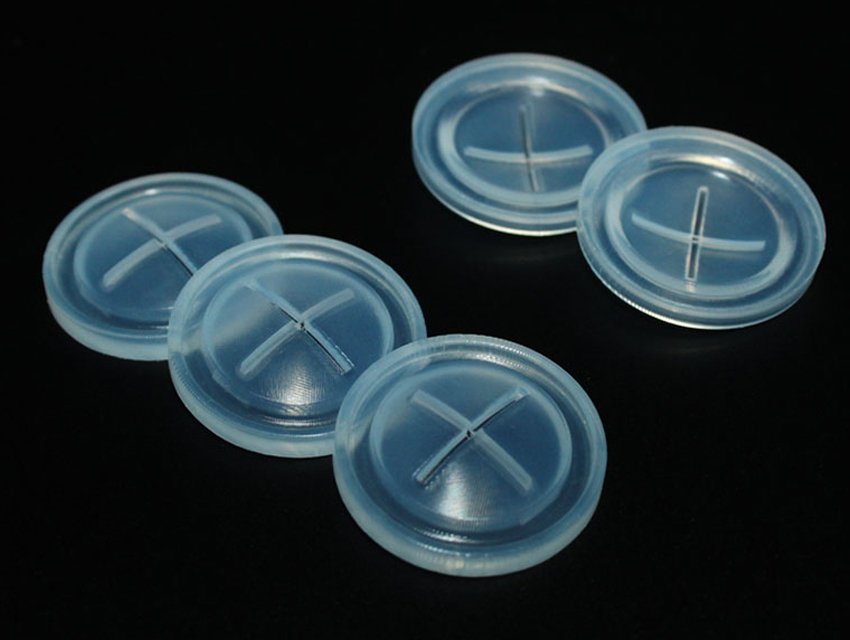

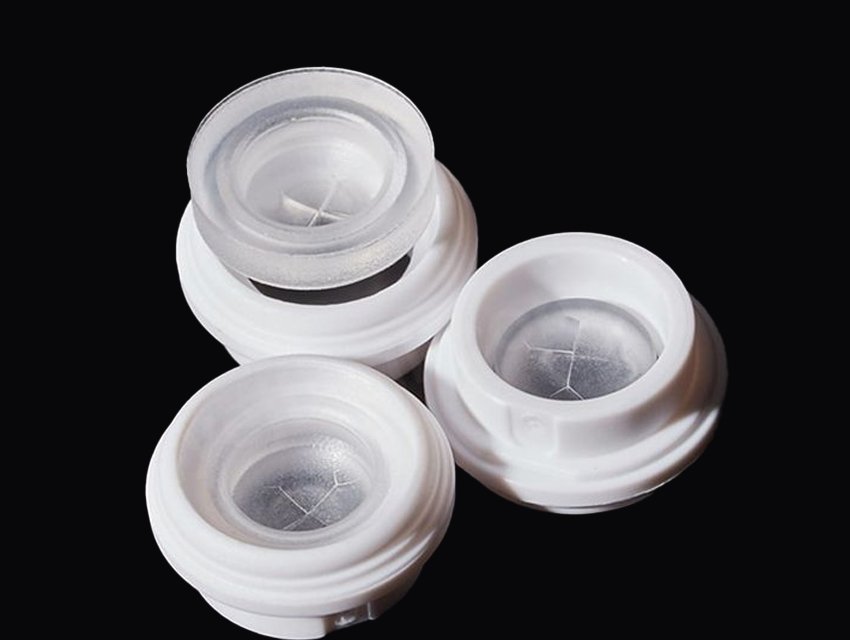
Opening behavior is mainly controlled by slit geometry, diaphragm thickness, material hardness, and the elastic recovery of the molded membrane.
| Property | Typical Guidance | Design Meaning |
|---|---|---|
| Hardness | Commonly 30 to 40 Shore A | Softer material lowers opening force, while higher hardness can improve closing force but increase actuation pressure. |
| Diaphragm Thickness | Application-specific; tight thickness control recommended | Thicker diaphragms generally need more force to open and can provide stronger sealing. |
| Slit Depth | Design guidance may use about one-third to two-thirds of membrane thickness | Insufficient depth can restrict opening, while excessive depth can weaken tear resistance and self-sealing. |
| Temperature Range | Silicone designs commonly target about -40°C to 230°C | The final limit depends on the silicone grade, media, sterilization, and service conditions. |
| Functional Testing | Leak and opening tests can be defined for the final application | Dispensing and medical programs often need tighter lot-to-lot control of slit closure and opening behavior. |
A cross-slit valve should be designed as a complete system that includes slit geometry, diaphragm stiffness, material recovery, and anti-sticking control.
Select the slit pattern around flow and sealing needs. Symmetry and cutting position directly affect whether each cusp opens evenly.
Thicker membranes increase opening force. Slit depth should allow full movement without weakening the diaphragm or reducing tear life.
Very soft material opens easily but may reduce sealing force or durability. Hardness should be matched to actuation pressure and target cycle life.
Medical access valves may require self-lubricating LSR or a controlled slit treatment to reduce the risk of slit surfaces bonding during storage or repeated sterilization.
Cross-slit valves are used when a product needs fast dispensing, self-closing flow control, or a flexible access opening that reseals after use.
Used in squeeze caps for sports drinks, sauces, honey, concentrates, and other products that need controlled dispensing and drip reduction.
Used in needle-free connectors, trocar valves, drug-delivery access ports, and other self-sealing medical interfaces.
Used in shampoo, body wash, detergent, and other squeeze-dispensing closures that should stop cleanly when pressure is released.
Used in condensate drainage and metering or injection systems that need compact elastomer flow control.
Share your target flow, opening pressure, fluid, diaphragm size, slit pattern, life-cycle, and compliance requirements. Fecision can review the valve geometry and molding or slitting approach.