
Buyer’s Background
For procurement teams sourcing components for diagnostic medical equipment, the buying decision is a three-way tension.
- The device operates in environments where HAIs (Hospital-Acquired Infections) like MRSA and C. difficile are existential risks. Surfaces must actively resist microbial colonization.
- Clinicians use these devices under pressure. Buttons must be instantly legible, tactilely intuitive, and comfortable during thousands of actuations per shift.
- Multi-color interfaces and surface finishes often imply secondary operations or multi-part assemblies.
Our client needed a keypad that delivered on all three fronts without inflating BOM cost or assembly complexity.
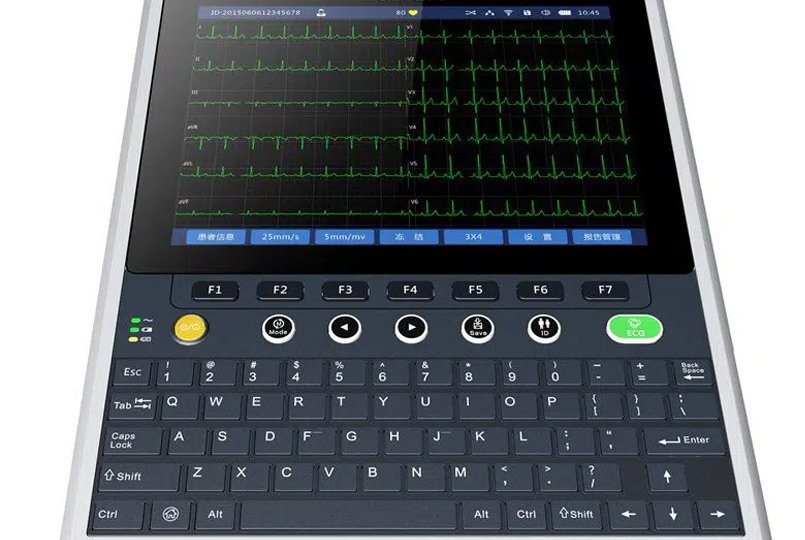
Product: A Multi-Color Silicone Rubber Keypad
The final component is a solid high-temperature vulcanized (HTV) silicone rubber keypad, manufactured through compression molding using multiple colored silicone rubber stock materials in a single tool.
Specifications:
- Process: silicone rubber compression molding (multi-color co-molding)
- Graphics: Multi-color silk-screen printing with solvent-based inks
- Surface Treatment: Precision grinding + soft-touch spray coating
- Functional Additive: Antimicrobial agent integrated into the outer coating
Challenges
This project presented a classic systems-engineering conflict. Four distinct requirements all interacted at the same physical interface, each carrying its own technical risk.
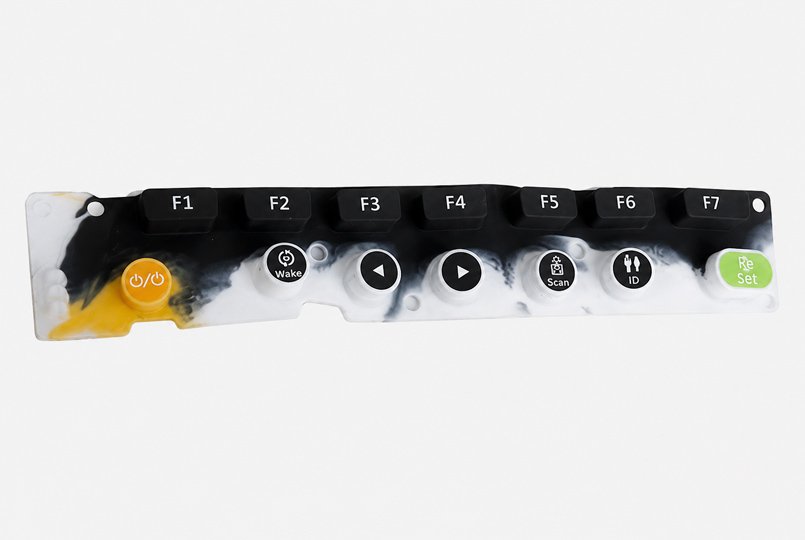
- Multi-Color Co-Molded Body. Solid silicone co-molding inevitably produces minor color bleed at the boundaries between color zones. This is a natural artifact of high-temperature flow and cure kinetics, not a process defect in the conventional sense. The challenge was accepting this reality while still delivering a visually clean final product.
-
Durable, Crisp Legends. Silk-screened graphics require a protective clear coat to survive hospital-grade disinfectant wipe-downs and years of actuation. Without this barrier, the ink would degrade rapidly under the aggressive cleaning protocols of a clinical environment.
-
Antimicrobial Efficacy: A standard protective clear coat would seal the surface, trapping any substrate-embedded antimicrobial agent underneath and rendering it ineffective against surface-contact bacteria. The coating would protect the ink, but it would simultaneously shield bacteria from any antimicrobial agents in the rubber below.
-
Tactile Feel. The surface needed to be smooth, matte, and soft-touch — not sticky, not glossy, not harsh on fingertips during extended clinical use. This is not merely an aesthetic preference; tactile fatigue directly impacts input accuracy during long shifts.
Treating the coating as a separate finishing step would have left the keypad’s requirements disconnected. The molded body and printed legends had to work with the final surface treatment, so the team developed them as one finished component.
Solution
We addressed the challenge through three integrated manufacturing decisions that turned competing requirements into complementary features.
- Multi-Color Molding + Design-for-Manufacturing (DFM) Rather than avoiding color bleed through expensive multi-shot LSR tooling or post-assembly color inserts, we leveraged the efficiency of solid silicone compression co-molding — loading multiple pre-colored silicone compounds into a single cavity.
Minor color wicking at color boundaries is an inherent characteristic of this process at high cure temperatures. Attempting to eliminate it entirely through process control alone would drive cycle times and scrap rates to economically unviable levels.
We worked with the client’s industrial design team during the mold-design phase to ensure that the keypad’s perimeter — where color bleed naturally occurs — would be concealed by the device’s front housing bezel after final assembly. The color bleed exists, but it exists in a zone that the end user will never see.
Business Impact for the Buyer: This DFM approach avoided a 40–60% tooling cost premium associated with cold-deck multi-material injection systems, while still achieving the desired multi-color aesthetic in the visible actuation zones. The “flaw” was designed out at the system level, not fought at the process level. The client received a multi-color keypad at a single-color tooling cost.
- Silk-Screen Printing with Antimicrobial Coating
Precision silk-screen printing produced clear legends that could be read under the expected clinical lighting. The graphics remained simple so users could identify the controls quickly.
However, the critical innovation was the co-developed soft-touch topcoat. We partnered with our antimicrobial additive supplier to formulate a clear, soft-touch polyurethane coating that simultaneously achieves three functions that would normally require three separate process layers.
It protects the silk-screened ink from abrasion and chemical attack, extending the functional life of the legends through years of wipe-downs and actuations. It distributes antimicrobial agents evenly across the outermost tactile surface, ensuring that every point of human contact is actively hostile to bacterial colonization.
It delivers a smooth, low-friction “soft-touch” feel that remains comfortable after thousands of presses, reducing tactile fatigue for clinicians working 12-hour shifts.
This single consolidated layer replaced what would otherwise have been a multi-step, multi-supplier process: a protective coating from one vendor, a secondary antimicrobial treatment from another, and a tactile finish from a third. The integration reduced failure modes, shortened lead times, and eliminated the interface risk between separate process owners.
Validation
In healthcare B2B procurement, supplier assertions are worthless without third-party evidence. A datasheet claim of “antimicrobial” does not survive a hospital infection control committee’s review. We submitted finished production-representative samples to an independent testing laboratory. Antimicrobial efficacy was evaluated against two clinically relevant organisms. Staphylococcus aureus — the gram-positive pathogen responsible for MRSA, representing the most feared hospital-acquired infection in surface-contact scenarios. Escherichia coli — a representative gram-negative bacterium, ensuring that the antimicrobial mechanism is effective across bacterial cell wall types.
Result: Significant bacterial reduction. The keypad passed all antimicrobial performance criteria established by the test protocol.
The test data gave the client evidence to share with hospital procurement and infection-control teams. It also supported the client’s regulatory review and helped distinguish the finished keypad from products described only by an additive supplier’s claims.