
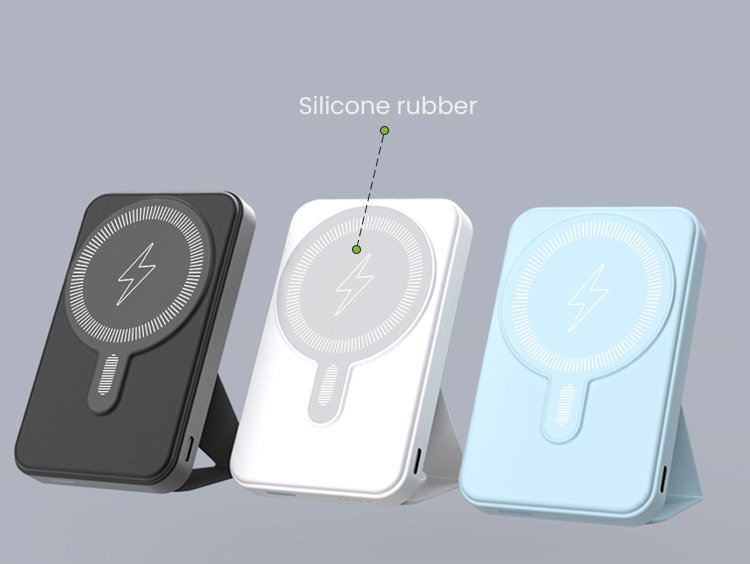
Choosing a gasket material is not a shopping decision but a systems decision. The elastomer that performs beautifully on a fuel line flange can fail within weeks on a steam joint, even though both are rubber gaskets. This rubber gasket material selection guide is written for guys who need to move from application requirements to a short list of viable materials and understand why those materials are the right choice.
Common Rubber Gasket Materials
Each material below has its advantages, limitations, typical service temperature range and common applications. Temperature ranges are typical commercial-grade figures; compound-specific formulations can change these ranges.
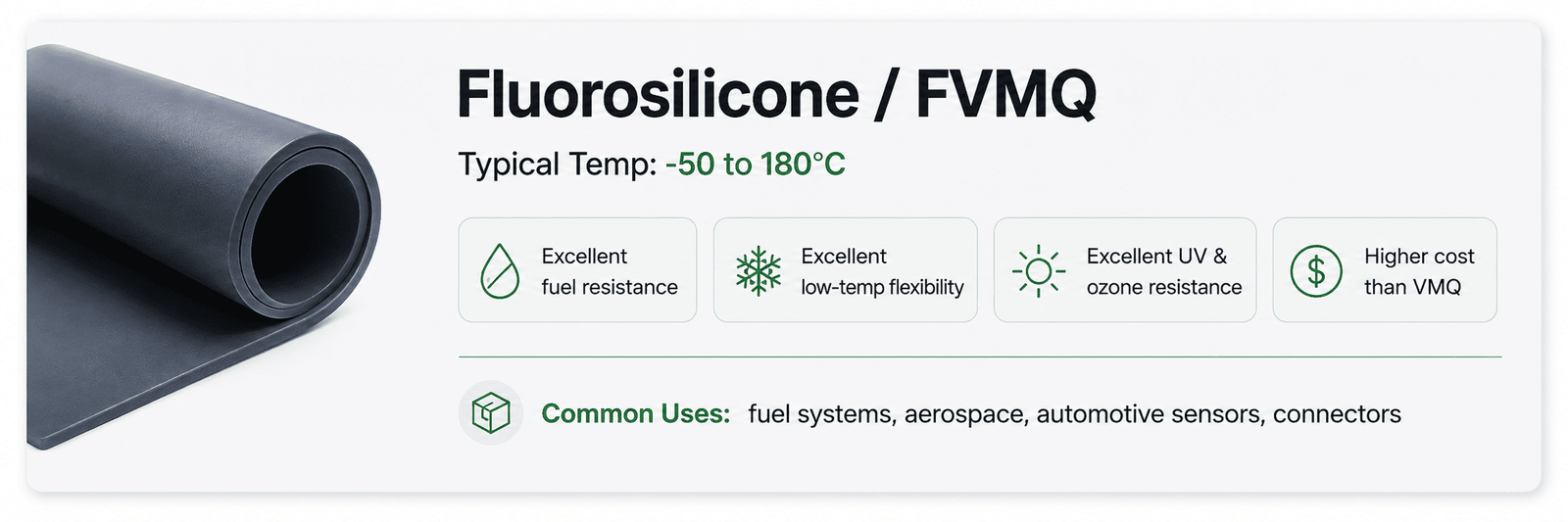
Silicone (VMQ)
Typical servie temp. range: −55°C to 200°C
Silicone, known by its technical designation VMQ, swaps out the carbon backbone found in most rubbers for a silicon-oxygen chain. That single structural difference explains almost everything unusual about it. It handles heat, UV, and ozone better than nearly any other elastomer, and it stays flexible in the cold. Many grades are physiologically inert enough to meet USP Class VI, so it turns up constantly in medical and food-contact parts. The catch is that silicone tears and abrades easily, and it has almost no resistance to fuel or oil. It runs from about −55°C to 200°C, with brief spikes tolerated above that, and shows up in oven seals and gaskets, outdoor light fixtures, HVAC housings, medical device housings, and food-contact gaskets.
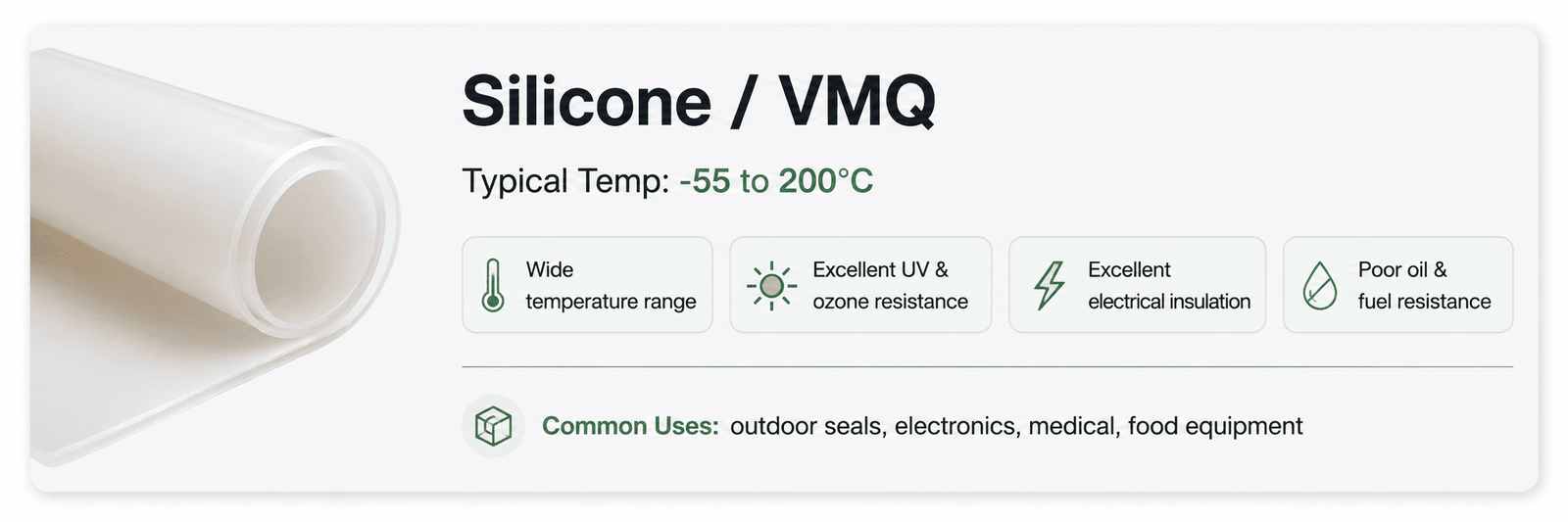
LSR (Liquid Silicone Rubber)
Typical servie temp. range: −50 °C to 200 °C
LSR, or liquid silicone rubber, is the same chemistry processed differently. Instead of being compression molded, it’s injected as a liquid, which makes thin, complex, high-precision parts practical at production volume. It inherits silicone’s wide temperature range and biocompatibility, and unfortunately its weak tear and abrasion resistance too. Tooling costs more, so LSR only makes sense once volume justifies it, in parts like micro-gaskets, connector seals, wearables, and medical components.
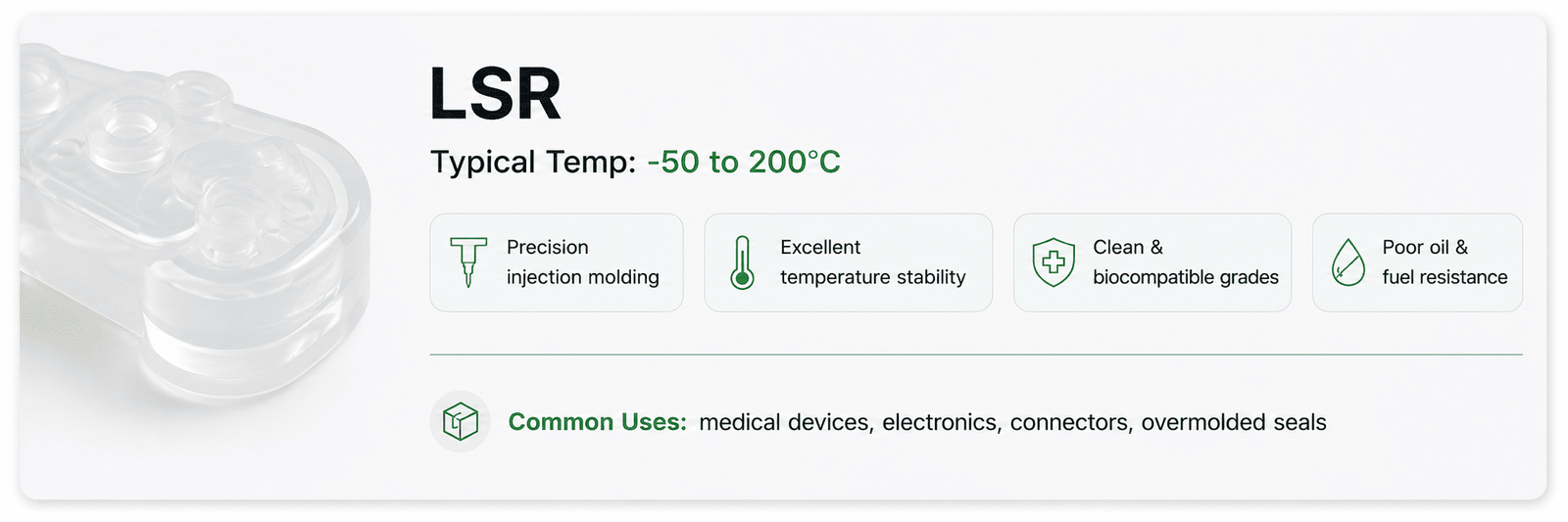
Fluorosilicone (FVMQ)
Typical servie temp. range: −50°C to 180°C
Silicone’s biggest weakness is that it has almost no fuel or oil resistance. A variant called fluorosilicone, or FVMQ, addresses that by adding fluorine to the side groups. That gets you noticeably better fuel and oil resistance without giving up much of silicone’s temperature range or cold-weather flexibility. It’s still weak on tear and abrasion resistance, still expensive, and still not meant for constant fuel immersion. For intermittent exposure combined with temperature extremes, though, it works where plain silicone wouldn’t. It covers roughly −50°C to 180°C and is common in aerospace fuel seals and automotive parts exposed to fuel vapor.
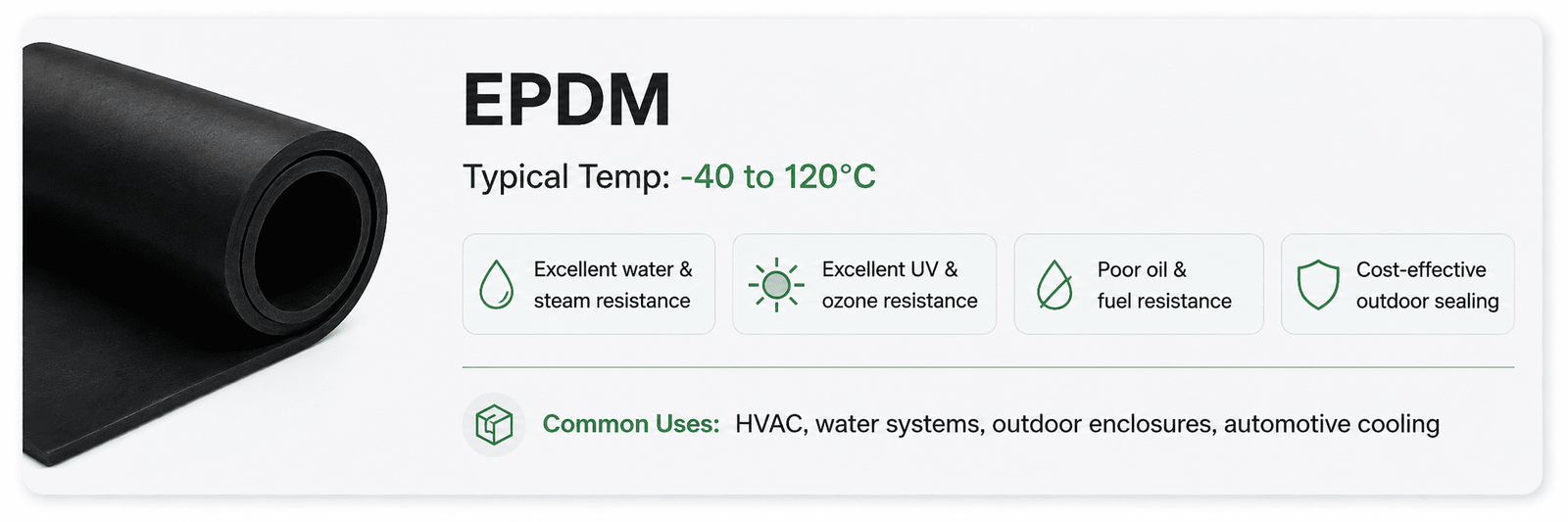
EPDM
Typical servie temp. range: −50°C to 150°C
Moving away from the silicone family entirely, EPDM is a terpolymer of ethylene, propylene, and a diene monomer. Its fully saturated backbone is what makes it so tough against weather. It resists ozone, UV, and weathering excellently, handles hot water and steam well, and costs relatively little, which is why it’s the default for weatherstripping, outdoor enclosures, plumbing seals, and HVAC gaskets. What it can’t do is touch oil or fuel. It swells and breaks down on contact with either, so it should never be specified anywhere near a lubricant. Its useful range runs −50°C to 150°C.
NBR
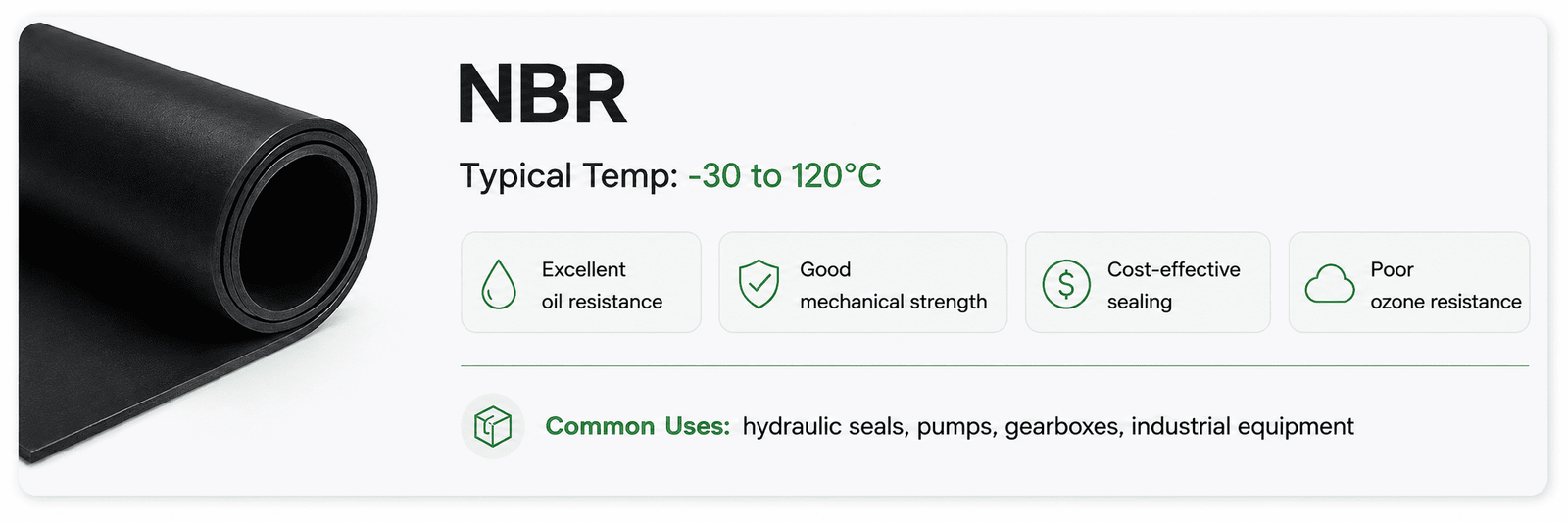
Typical servie temp. range: −30°C to 120°C
Where EPDM struggles is exactly where nitrile rubber, or NBR, excels, and that’s petroleum oils and fuels. NBR is a copolymer of acrylonitrile and butadiene. More acrylonitrile means better oil resistance at the cost of worse cold-weather flexibility, a direct trade built into the chemistry. It’s cheap, reasonably abrasion resistant, and effective from about −30°C to 120°C, which makes it the workhorse for fuel system gaskets, hydraulic seals, and engine components. Its weak point is ozone and UV resistance. An unprotected NBR part left outdoors will crack within a couple of seasons, so it belongs indoors or in an enclosed hydrocarbon environment, not in the sun.
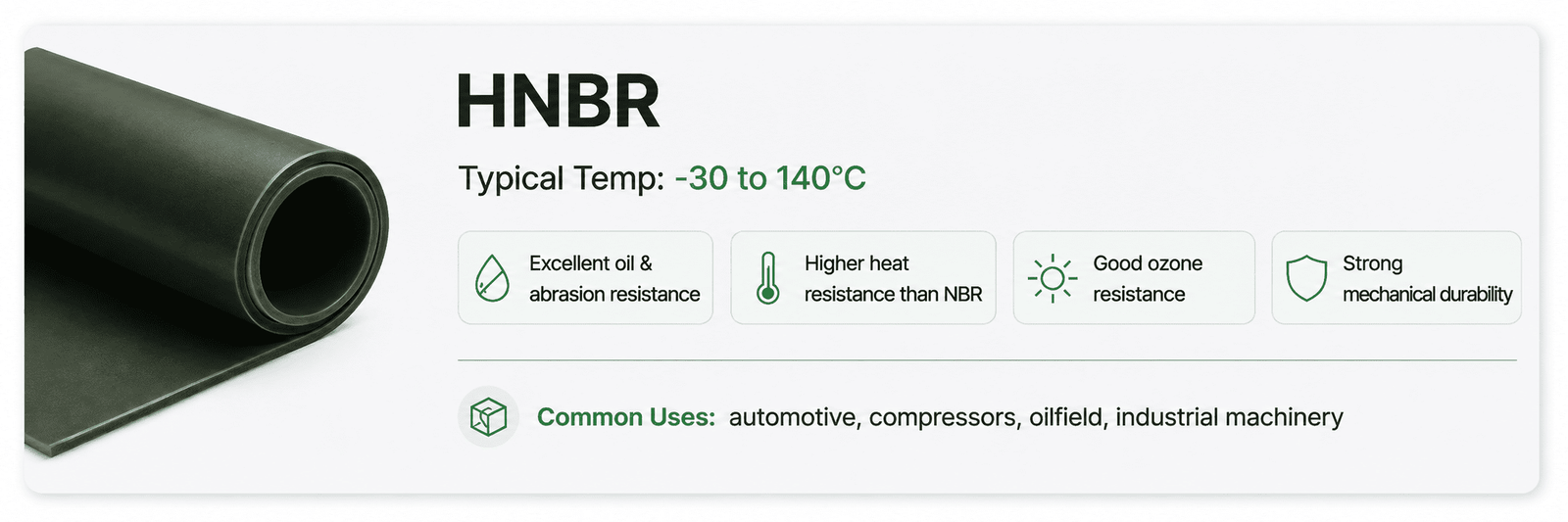
HNBR (Hydrogenated Nitrile)
Typical servie temp. range: −40 to 150 °C
Take NBR and hydrogenate away most of its remaining double bonds, and you get HNBR. It’s a material that keeps the oil resistance but removes the sites that made regular nitrile vulnerable to heat and ozone. The result handles temperatures up to roughly 150°C, resists abrasion well, and has higher tensile strength than standard NBR, all at a meaningfully higher price. That combination of oil resistance and heat tolerance is why HNBR ends up in timing belts, oil seals, and turbocharger hoses, places where hot oil and mechanical wear happen together.
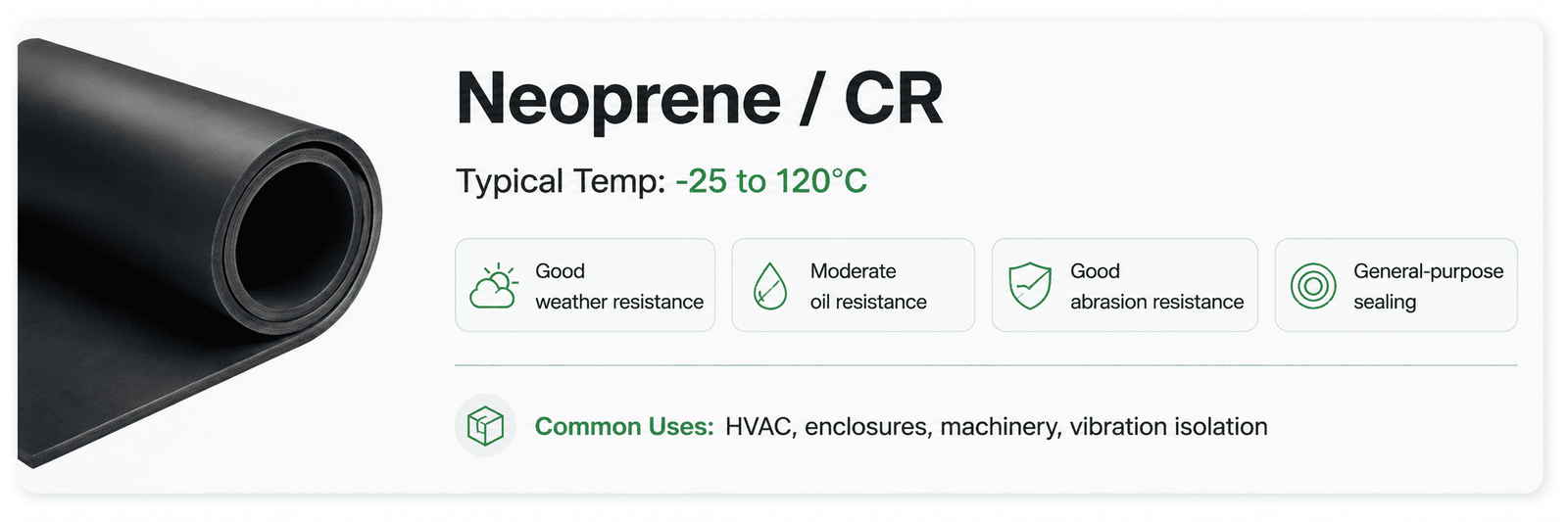
Neoprene / CR
Typical servie temp. range: −40°C to 120°C
Neoprene, or CR, doesn’t try to lead in any single category the way NBR or EPDM do. It was one of the first synthetic rubbers ever made, and the chlorine in its structure gives it natural flame retardancy along with a fairly even spread of moderate oil resistance and good weathering. Nothing about it stands out, but nothing about it is bad either, which makes it a reasonable generalist for marine seals, HVAC ductwork, and industrial gaskets that see some oil exposure and some weathering, but not much of either at the extreme. It covers −40°C to 120°C.
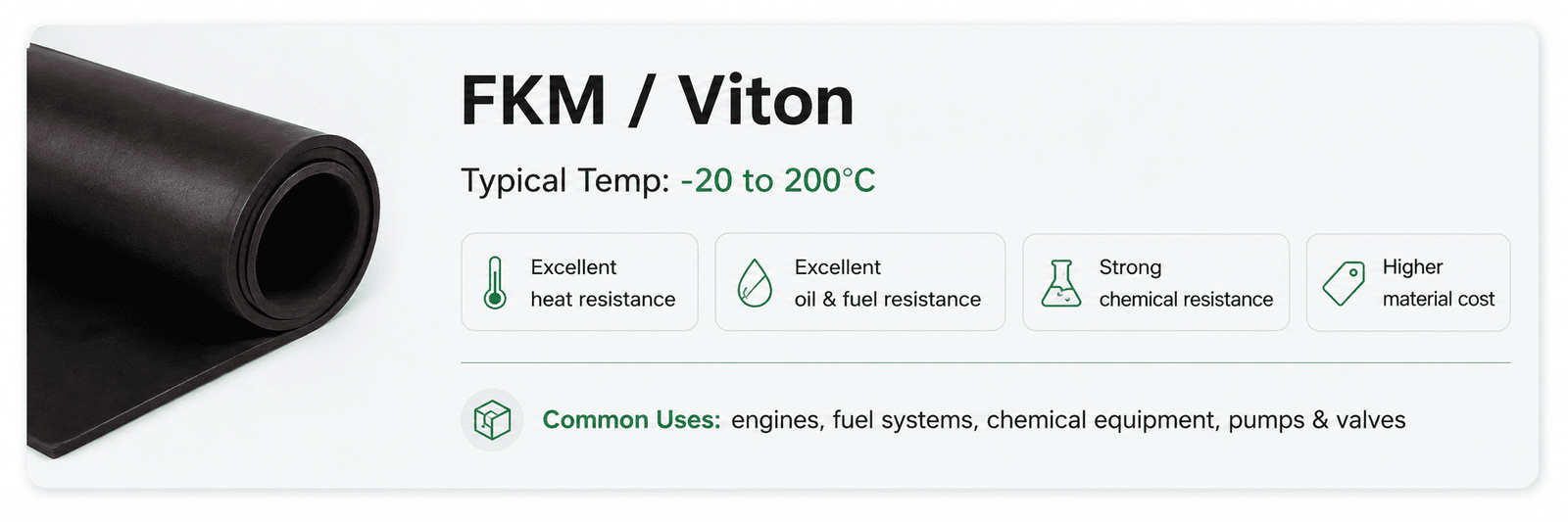
FKM / Viton
Typical servie temp. range: −40°C to 200°C
For applications where NBR and HNBR still aren’t chemically resistant enough, FKM, sold under the Viton brand by Chemours, is usually the next step up. Its high fluorine content drives strong resistance to fuels, oils, and a wide range of chemicals, along with good performance up to roughly 200°C and low gas permeability. The tradeoff shows up at the cold end. Standard grades stiffen below about −20°C, though low-temperature grades push that down to −40°C. It’s also considerably more expensive than NBR or EPDM. Even so, that mix of chemical resistance and heat tolerance makes it the standard choice for automotive fuel systems, turbocharger seals, and valve gaskets in chemical processing and oil and gas.
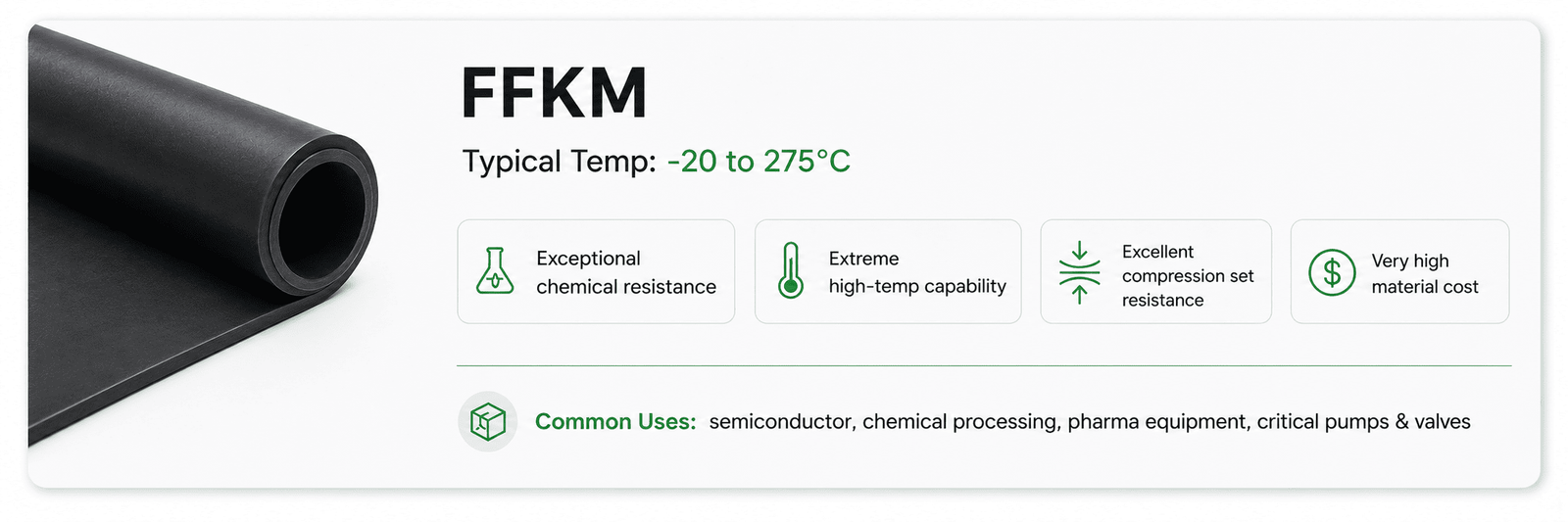
FFKM
Typical servie temp. range: −15 °C to 327 °C
FFKM pushes that same fluorination logic to an extreme, leaving barely any hydrogen on the backbone at all. It behaves like a rubber but resists chemicals almost the way PTFE does, and it can handle service up to 327°C depending on the grade. The cost is often ten to fifty times what FKM costs, so FFKM is reserved for situations where nothing else survives, such as semiconductor processing equipment, aggressive chemical reactors, and aerospace engine seals.
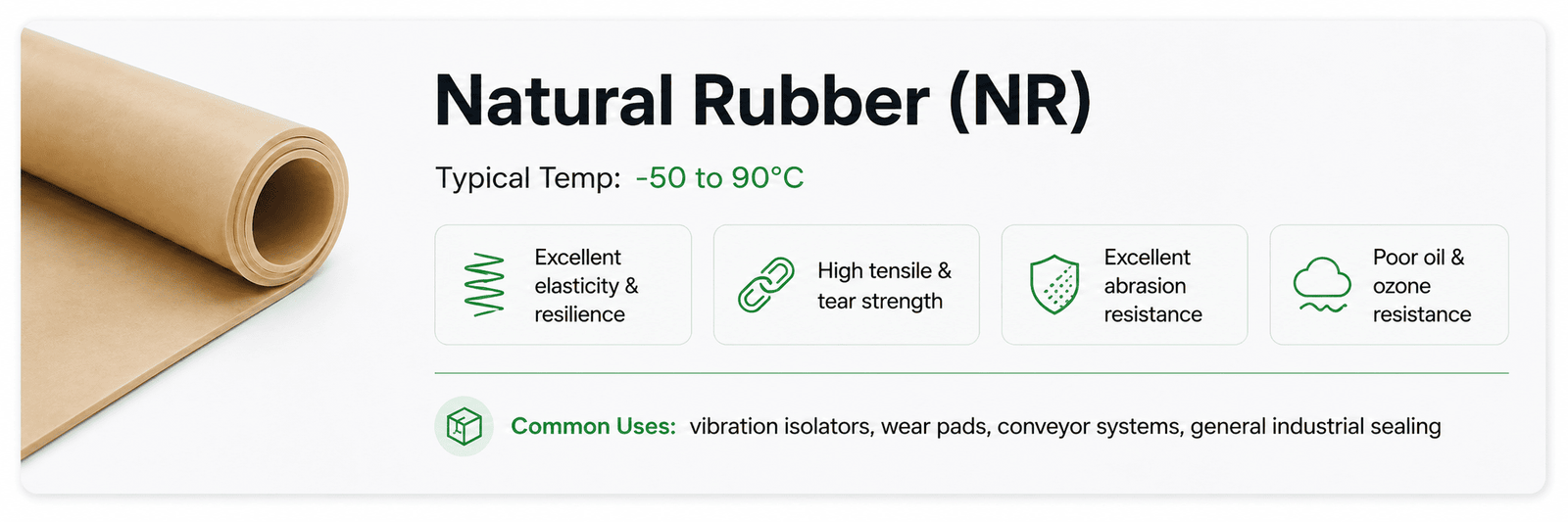
Natural Rubber (NR)
Typical servie temp. range: −50 °C to 80 °C
Stepping away from chemical and fuel resistance entirely, natural rubber wins on pure mechanical properties. Derived straight from the sap of the rubber tree, its long, uniform polyisoprene chains give it the best combination of tensile strength, elongation, and abrasion resistance among common elastomers. That makes it excellent for vibration isolators and shock mounts, since dynamic loading rather than fluid exposure is its natural habitat. Put it near oil or sunlight, though, and it degrades quickly. It wasn’t built for either. It runs from −50°C to 80°C.
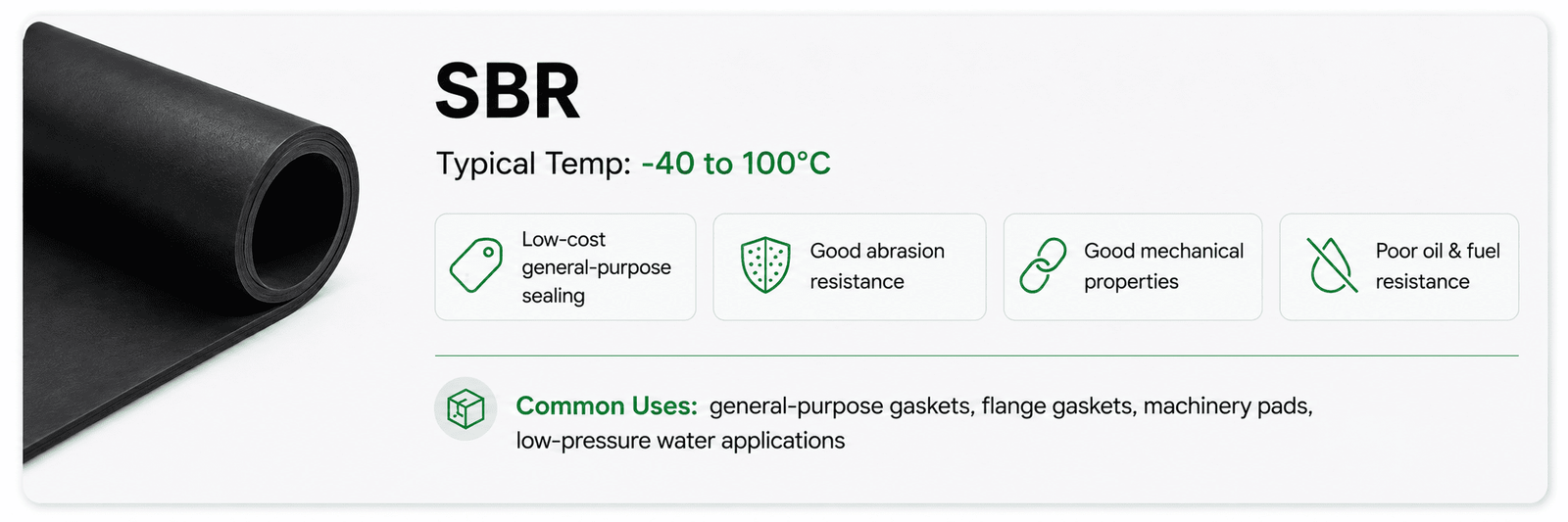
SBR
Typical servie temp. range: −40 °C to 100 °C
SBR exists mainly as a cheaper substitute for natural rubber. It’s a synthetic copolymer of styrene and butadiene that approximates NR’s mechanical behavior without matching its peak performance, and it shares the same vulnerability to oil, fuel, and ozone. That combination confines it to non-critical, indoor, non-hydrocarbon uses such as general automotive gaskets and low-cost washers, across roughly −40°C to 100°C.
Butyl Rubber (IIR)
Typical servie temp. range: −40 °C to 150 °C
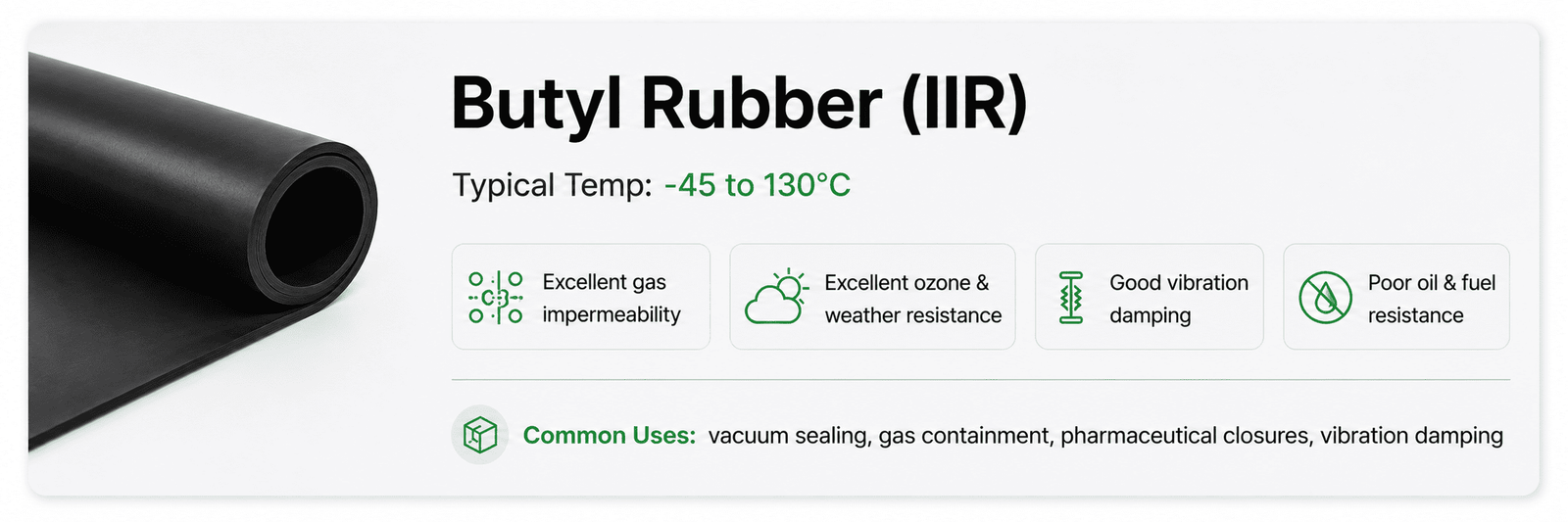
None of the materials covered so far are particularly good at blocking gas or moisture vapor from simply diffusing straight through them. That’s where butyl rubber, or IIR, comes in. It’s a copolymer of isobutylene with a small amount of isoprene, and its tightly packed molecular structure gives it the best gas and moisture vapor barrier of any common elastomer, along with solid resistance to weathering and to polar chemicals like acids and alkalis. Its blind spot is the same as EPDM’s. It swells badly in petroleum oils and fuels. Typical service runs −40°C to 150°C, and it’s the standard pick for vacuum seals, pharmaceutical vial stoppers, tire liners, and insulating glass seals.
Polyurethane
Typical servie temp. range: −40 °C to 80 °C
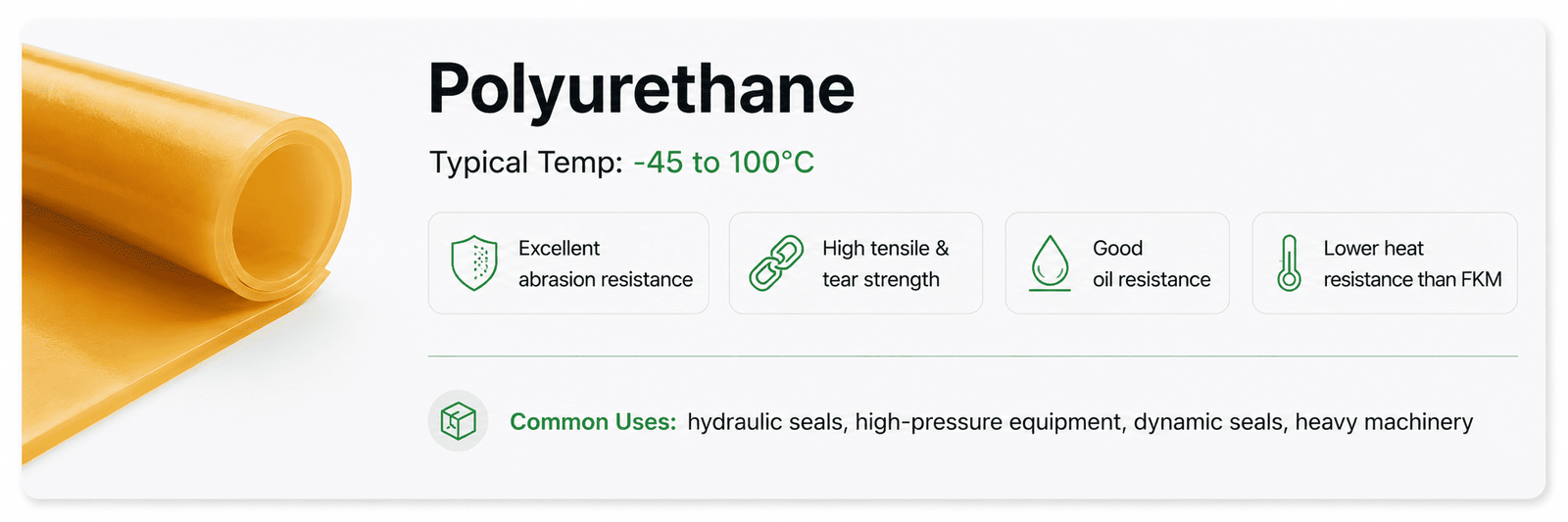
Switching focus from chemical resistance to physical wear, polyurethane is the material to reach for when abrasion is the dominant threat. It’s built from urethane linkages between polyols and diisocyanates, and its segmented hard-soft block structure gives it unusually high abrasion resistance, tensile strength, and tear resistance for a rubber, plus decent oil resistance. What it can’t handle is sustained heat or steam. It hydrolyzes and breaks down in hot water, so it’s ruled out of steam service entirely. It typically covers −40°C to 80 to 100°C and shows up in high-wear die-cut gaskets, wiper seals, and rollers.
PTFE
Typical servie temp. range: −200 °C to 260 °C
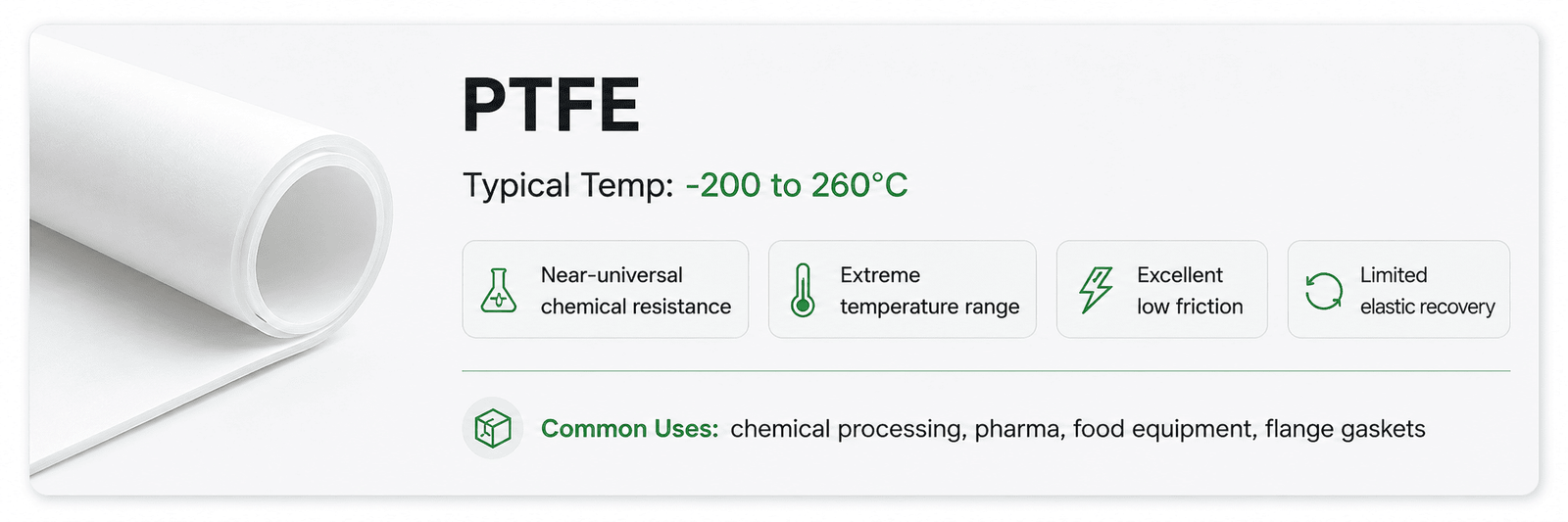
At the far end of chemical resistance sits PTFE, which technically isn’t an elastomer at all. It’s a fluoropolymer. Its carbon-fluorine bonds make it almost completely inert, and it works from cryogenic temperatures up to 260°C. The catch is that it doesn’t spring back the way rubber does, so PTFE gaskets are usually used in expanded, filled, or spring-energized form, and the joint needs higher bolt loads to seal properly. That tradeoff is accepted in chemical processing flanges, high-purity semiconductor piping, and food and pharmaceutical processing, where PTFE’s chemical inertness outweighs its poor elastic recovery.
Sponge / Foam Rubber
Typical servie temp. range: silicone sponge: −60 °C to 200 °C; EPDM sponge: −40 °C to 120 °C
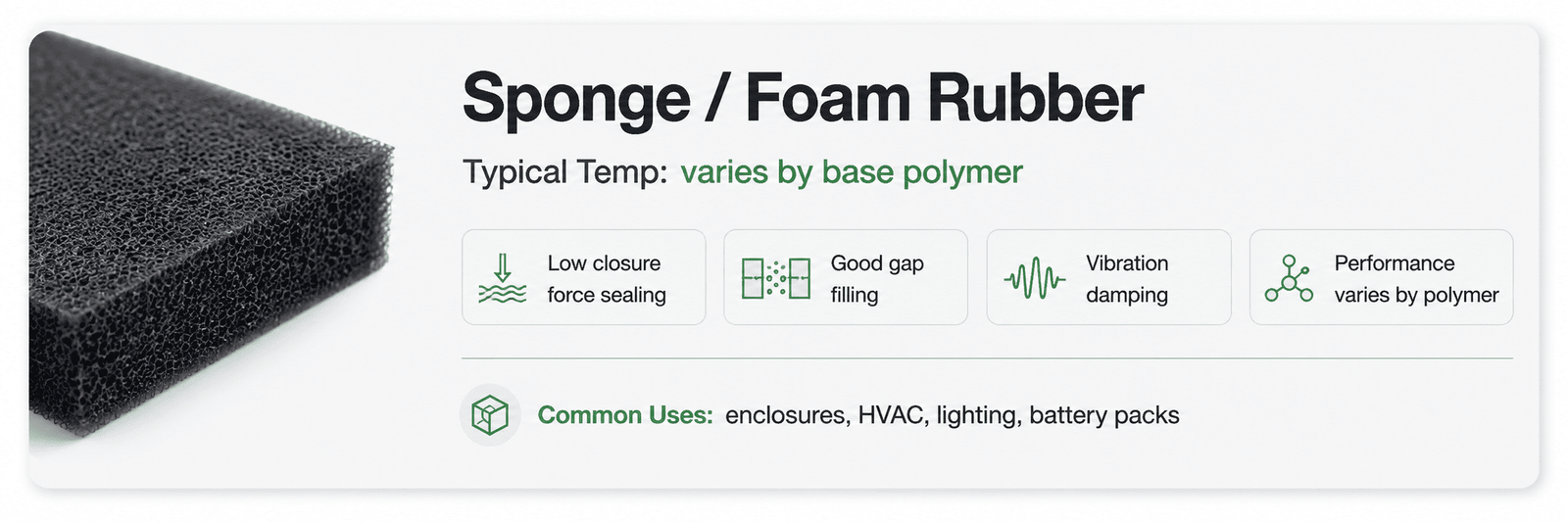
Every material described above can also be produced as a foam. Sponge and foam rubber aren’t a separate polymer family. They’re a cellular version of an existing base rubber, most often silicone, EPDM, neoprene, or polyurethane, made with open or closed cells to cut density and reduce the force needed to compress them. They inherit the temperature and chemical behavior of whatever base rubber they’re built from, but they aren’t meant for pressurized fluid sealing. Instead they excel at low-force gap filling for enclosures, dust, and water, such as IP-rated electronics housings, cabinet doors, and HVAC duct gaskets.
Gasket Applications
A gasket is asked to do one or more of a handful of jobs. It blocks liquids and gases from escaping a joint, keeps water and dust out of an enclosure, holds against internal pressure without extruding, absorbs vibration and shock, provides an electrical insulating barrier between conductive surfaces, or shields a component from an aggressive chemical environment. Most real gaskets combine two or three of these at once. A battery pack seal, for instance, is simultaneously a water and dust barrier and a dielectric layer, and the material has to satisfy whichever combination the application demands.
Rather than treat requirements as a separate topic, it’s more useful to walk through what real components in each industry actually need, since the requirement is usually inseparable from the specific part.
Automotive
In automotive work, a valve cover or oil pan gasket sits directly against hot engine oil and needs NBR, or HNBR where temperatures run higher and abrasion is a factor. A door seal or trunk weatherstrip faces years of sun and road weather with no oil exposure at all, which is exactly the environment EPDM is built for. Swap the two and both fail, for opposite reasons. One swells in oil, the other cracks in sunlight.
EV and Battery Systems
EV and battery enclosures push that same logic further out in time. They need to stay sealed for the vehicle’s entire service life without any maintenance access, which puts a premium on low compression set over a decade or more. Silicone and EPDM, usually in foam or sponge form, cover most pack-level IP67 and IP69K sealing, and flame-retardant silicone is specified near cell modules where thermal runaway venting is a design consideration and dielectric performance matters as much as keeping water out.
Medical
Medical devices add a regulatory layer on top of the usual mechanical demands. They’re sterilized repeatedly by autoclave, gamma, or ethylene oxide, and any gasket in the fluid or tissue path has to meet biocompatibility standards such as USP Class VI or ISO 10993. That combination of steam exposure, low extractables, and traceability is why LSR and medical-grade silicone dominate device housings, with EPDM reserved for heavier equipment that cycles through autoclaves constantly but has lower biocompatibility requirements.
Electronics
Electronics enclosures ask for something simpler, a low-force gasket that keeps dust and moisture out for years without a technician ever touching it. Silicone and EPDM sponge gaskets are the standard for IP-rated housings, and where the enclosure also carries a flammability rating like UL 94, the foam has to meet that too.
Industrial Equipment
Industrial equipment covers too much ground to generalize about, but the same pattern holds up. An oil-lubricated gearbox seal calls for NBR or HNBR. A seal in an abrasive slurry line calls for polyurethane, regardless of whether oil is involved. A static gasket with no lubricant contact can often get away with EPDM or neoprene at a lower cost.
Pumps and Valves
Pumps and valves make the underlying point especially clear. It’s the process fluid, not the equipment type, that drives material selection. A water valve seals fine with EPDM. The same valve body handling a hydrocarbon process fluid needs FKM instead. One handling an aggressive or mixed chemical stream may need FFKM or PTFE. Shaft and stem seals add dynamic sealing and abrasion on top of that chemical question.
Oil and Gas
Oil and gas service adds sour gas, amines, high pressure, and rapid pressure drops on top of the chemical exposure already seen in general oil handling. Rapid pressure drops cause explosive decompression in trapped elastomers, which is its own design consideration. FKM and HNBR cover much of this, but sour and amine-heavy environments often call for Aflas instead, and downhole seals are frequently qualified against standards like NORSOK M-710 specifically for decompression resistance.
Chemical Processing
Chemical processing pushes the fluid-first logic to its extreme. A gasket needs to be matched to the exact chemical and concentration in front of it, not to a broad category. Chemical resistant isn’t a real specification. A single plant might legitimately need three different gasket materials at three different flanges. PTFE or FFKM handle the most aggressive or mixed streams, EPDM handles polar chemicals like alcohols and many acids and bases, and FKM handles most hydrocarbons and common solvents.
Food and Beverage
Food and beverage equipment cycles through CIP and SIP washdown routinely, and any gasket in the product path needs FDA or EU 1935/2004 compliance on top of its mechanical properties. FDA-grade silicone covers most flexible, heat-tolerant needs. EPDM handles equipment that sees frequent steam sterilization. FDA-grade NBR gets specified where the product line involves fats and oils, such as dairy processing, since plain silicone or EPDM wouldn’t hold up to sustained fat contact.
Energy
Energy infrastructure splits into two very different environments under one label. Solar and wind equipment enclosures face years of outdoor UV and ozone exposure, which again points to EPDM. Steam turbine and boiler gaskets face continuous high-temperature steam instead, which points toward PTFE or high-temperature EPDM.
Performance Requirements
Once the application’s environment is understood, material selection comes down to matching a specific set of measurable properties against it. These are the ones worth checking against a datasheet before committing to a material.
Operating Temperature
Operating temperature sets the outer bounds of usefulness. Too cold and the elastomer stiffens and loses sealing contact. Too hot and it hardens, degrades, or in extreme cases melts. It’s worth checking transient excursions as well as steady-state temperature, since a brief spike can do damage the material’s continuous rating wouldn’t suggest.
Compression Set
Closely related is compression set, which describes how much of a compressive deformation fails to recover once the load is removed, expressed as a percentage. A gasket with poor compression set relaxes over time and eventually stops applying enough force to seal. That matters far more for static seals torqued once and expected to hold for years, such as enclosures and flange gaskets, than for seals recompressed every time they’re used.
Hardness
Hardness is a separate question. It governs how easily a gasket conforms to an imperfect mating surface and how well it resists extruding out of the joint under pressure. Softer compounds seal low-pressure, uneven joints more readily. Harder compounds are needed as system pressure rises, to keep the material from squeezing out of the gap.
Tensile Strength and Elongation
Tensile strength and elongation determine whether a gasket survives installation and thermal cycling without tearing. Elongation matters especially for gaskets stretched over ribs or features during assembly, or put through repeated expansion and contraction as temperature swings.
Tear Resistance
Tear resistance is related but distinct. It’s about whether a small nick or cut propagates into a larger failure, which matters most for thin, complex die-cut shapes and gaskets that get handled repeatedly during service.
Oil and Fuel Resistance
Oil resistance and fuel resistance sound similar but aren’t interchangeable. Gasoline, diesel, and biofuels attack elastomers differently than general lubricating oils do, so a material rated for oil exposure shouldn’t be assumed fuel compatible without checking fuel-specific data. Ethanol-blended fuels in particular change swelling behavior compared to conventional gasoline.
UV and Ozone Resistance
UV and ozone resistance governs surface cracking and long-term embrittlement in sunlight. NBR, SBR, and natural rubber are especially vulnerable without protective additives, which is the main reason they rarely get specified outdoors despite being cheap.
Weather Resistance
Weather resistance is really a composite of all of the above, UV, ozone, temperature cycling, and moisture acting together. It’s the property most relevant to anything living in an outdoor or semi-outdoor enclosure over multiple years.
Gas Permeability
Gas permeability measures how much gas diffuses straight through the elastomer itself, independent of any leak path around it. This matters for vacuum systems, pressurized gas seals, and packaging where shelf life depends on the seal material’s own barrier properties, not just how well it fits.
Abrasion Resistance
Abrasion resistance decides wear life wherever a gasket rubs against something, contacts particulates, or experiences friction during installation. It’s the deciding factor in slurry seals or wiper seals, where mechanical wear rather than chemical attack is the main failure mode.
Electrical Insulation
Electrical insulation, expressed as dielectric strength and volume resistivity, matters whenever a gasket also functions as a barrier between conductive surfaces, as in battery pack seals or electronics enclosures. It needs to be evaluated alongside, not instead of, the sealing requirement.
Flame Resistance
Flame resistance becomes a hard requirement wherever a flammability standard applies. UL 94 governs electronics, FMVSS 302 governs automotive interiors, and various rail and aerospace standards apply elsewhere. Some elastomers, like neoprene and silicone, are inherently flame retardant. Others need additive packages to meet a given rating.
Gasket Material Comparison Table
| Material | Temp Range | Compression Set | Mechanical Strength | Oil Resistance | Fuel Resistance | Chemical Resistance | Water/Steam Resistance | UV/Ozone Resistance | Weather Resistance | Abrasion Resistance | Gas Permeability (lower is better barrier) | Electrical Insulation | Relative Cost |
|---|---|---|---|---|---|---|---|---|---|---|---|---|---|
| Silicone (VMQ) | −60 to 200 °C | Good | Poor | Poor | Poor | Moderate | Moderate | Excellent | Excellent | Poor | Moderate | Excellent | Moderate |
| LSR | −50 to 200 °C | Good | Poor to Moderate | Poor | Poor | Moderate | Moderate | Excellent | Excellent | Poor | Moderate | Excellent | Moderate to High |
| Fluorosilicone (FVMQ) | −60 to 175 °C | Good | Poor | Good | Good | Moderate | Moderate | Excellent | Excellent | Poor | Moderate | Good | High |
| EPDM | −50 to 150 °C | Good | Good | Poor | Poor | Moderate | Excellent | Excellent | Excellent | Moderate | Moderate | Excellent | Low to Moderate |
| NBR | −30 to 120 °C | Moderate | Good | Excellent | Good | Moderate | Moderate | Poor | Poor | Good | Moderate | Moderate | Low |
| HNBR | −40 to 150 °C | Good | Excellent | Excellent | Good | Good | Good | Good | Good | Excellent | Moderate | Moderate | Moderate to High |
| Neoprene (CR) | −40 to 120 °C | Moderate | Good | Moderate | Poor | Moderate | Good | Good | Good | Good | Moderate | Moderate | Low to Moderate |
| FKM / Viton | −20 (−40 low temp) to 200 °C | Good | Good | Excellent | Excellent | Excellent | Moderate | Good | Excellent | Good | Excellent | Good | High |
| FFKM | −15 to 327 °C | Excellent | Moderate | Excellent | Excellent | Excellent | Excellent | Excellent | Excellent | Moderate | Excellent | Good | Very High |
| Natural Rubber (NR) | −50 to 80 °C | Moderate | Excellent | Poor | Poor | Poor | Moderate | Poor | Poor | Excellent | Moderate | Moderate | Low |
| SBR | −40 to 100 °C | Moderate | Moderate | Poor | Poor | Poor | Moderate | Poor | Poor | Good | Moderate | Moderate | Very Low |
| Butyl (IIR) | −40 to 150 °C | Moderate | Moderate | Poor | Poor | Good | Good | Excellent | Excellent | Moderate | Excellent | Excellent | Low to Moderate |
| Polyurethane (PU) | −40 to 80/100 °C | Moderate | Excellent | Good | Moderate | Poor to Moderate | Poor | Good | Good | Excellent | Moderate | Moderate | Moderate |
| PTFE | −200 to 260 °C | Poor (as solid PTFE) | Moderate | Excellent | Excellent | Excellent | Good | Excellent | Excellent | Good | Excellent | Excellent | Moderate to High |
| Sponge/Foam (base dependent) | Inherits base polymer | Moderate to Good | Poor | Base dependent | Base dependent | Base dependent | Base dependent | Base dependent | Base dependent | Poor | Poor | Base dependent | Low to Moderate |
Ratings are typical and comparative rather than compound-specific guarantees. Confirm against the manufacturer’s datasheet and, in borderline cases, test directly against the actual service fluid and duty cycle.
Material Selection Recommendations
High- and Low-Temperature Sealing
Temperature is usually the first filter. Above roughly 150°C, FKM is the general workhorse when cost needs to stay reasonable. Silicone works better when the environment is dry and free of oil or fuel and flexibility across a wide range matters more than chemical resistance. FFKM or PTFE take over when extreme heat and aggressive chemicals show up together. At the other end, below about −40°C, silicone and fluorosilicone stay flexible furthest into the cold, while standard FKM stiffens early, below roughly −20°C, unless a specific low-temperature grade is chosen. PTFE handles true cryogenic service, but the joint design needs to account for its poor elastic recovery.
Oil and Fuel Sealing
Once temperature is settled, fluid exposure usually decides the rest. For oil sealing, NBR is the default where cost matters most. HNBR steps in when higher heat or abrasion is also present. FKM earns its higher cost when oil exposure is combined with high temperature or when long-term compression set really matters. For fuel sealing specifically, FKM is the modern standard across gasoline, diesel, and biofuel blends. NBR is still viable and cheaper for conventional fuel, but its compatibility with ethanol blends should be checked rather than assumed.
Outdoor and Steam Sealing
Outdoor and environmental exposure follows a different logic entirely. For general outdoor sealing, EPDM is the default for UV, ozone, and weather resistance at reasonable cost, with neoprene as an alternative where some oil exposure is also expected. NBR, SBR, and unprotected natural rubber should stay indoors regardless of their other strengths. For steam sealing, EPDM again offers the best cost-to-performance ratio, PTFE takes over for high-purity or chemically aggressive steam systems, and both polyurethane and standard NBR should be avoided since they hydrolyze under sustained steam.
Chemical Environments
Chemical environments need to be handled fluid by fluid rather than by category. PTFE or FFKM cover aggressive or mixed exposure, EPDM covers polar chemicals like alcohols, ketones, and many acids and bases, FKM covers most hydrocarbons and common solvents, and Aflas is worth reaching for specifically with amines and sour gas.
Medical and Food-Contact Applications
Regulated applications add certification on top of chemistry. Medical applications lean almost entirely on LSR and medical-grade silicone because of biocompatibility, autoclave tolerance, and regulatory traceability, with EPDM reserved for equipment that autoclaves constantly but carries lower biocompatibility requirements. Food-contact applications follow a similar pattern. FDA or EU-compliant silicone covers most flexible, heat-tolerant needs, EPDM handles frequent steam and CIP cleaning, and FDA-grade NBR is worth specifying wherever fats and oils are involved, since plain silicone doesn’t hold up as well to sustained fat contact.
EV Battery and Vacuum/Gas Sealing
Electrical and barrier applications share a common thread. EV battery sealing leans on silicone and EPDM, usually in foam form, because of low compression set over the vehicle’s service life, availability in flame-retardant grades, and good dielectric properties. Seals near cell modules often get flame-retardant silicone rated specifically for thermal-runaway venting. For electrical insulation more generally, silicone and EPDM offer the best balance of dielectric strength and durability, while butyl rubber stands out for combining insulation with very low gas and moisture permeability, useful in sealed electrical enclosures. Vacuum or gas sealing follows that same permeability logic. Butyl rubber is the standard choice, FKM or FFKM take over when the seal also has to survive chemical or high-temperature exposure, and silicone and EPDM should be avoided here despite their other strengths, since permeation is exactly what they’re weak at.
High-Abrasion Applications
For high-abrasion applications, polyurethane is the standard choice thanks to its exceptional abrasion and tear resistance, with HNBR as the alternative when oil exposure comes along with the wear.
Practical Selection Checklist
Before finalizing a material, it helps to work through a short list of questions.
- What fluids will the gasket actually contact, including cleaning agents and incidental exposure, not just the primary process fluid?
- What is the full temperature range, including transient excursions rather than just steady-state operation?
- Is the seal static or dynamic, and does it need to survive repeated compression cycles or hold indefinitely under one compression?
- Are there regulatory or certification requirements, such as FDA, USP Class VI, UL 94, NORSOK, or REACH/RoHS, that narrow the field before performance data even comes into play?
And finally, has the shortlisted material actually been validated against the real service conditions? Published compatibility charts are a starting point for elimination, not a substitute for testing in borderline cases.
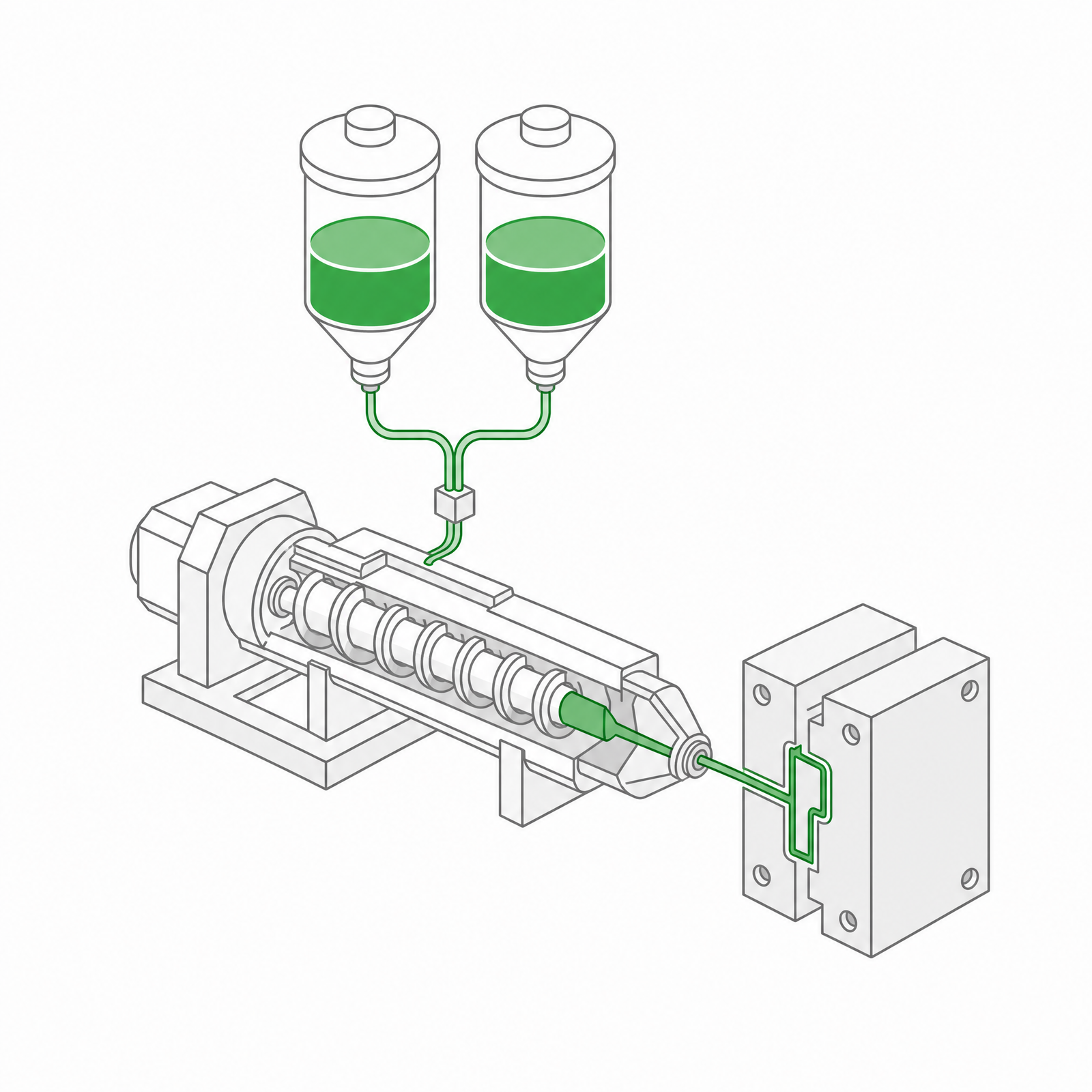 LSR Injection Molding
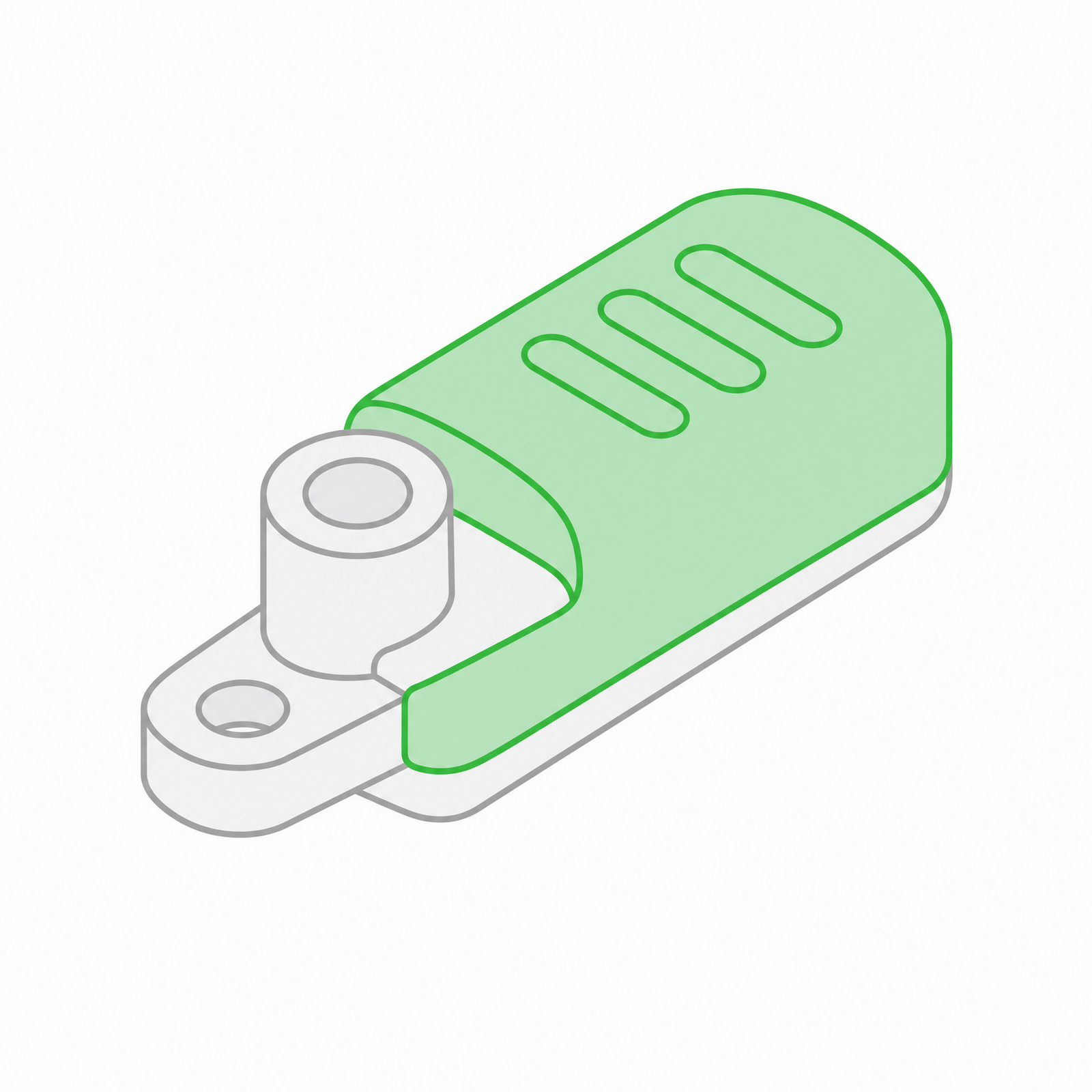 Silicone Rubber Overmolding
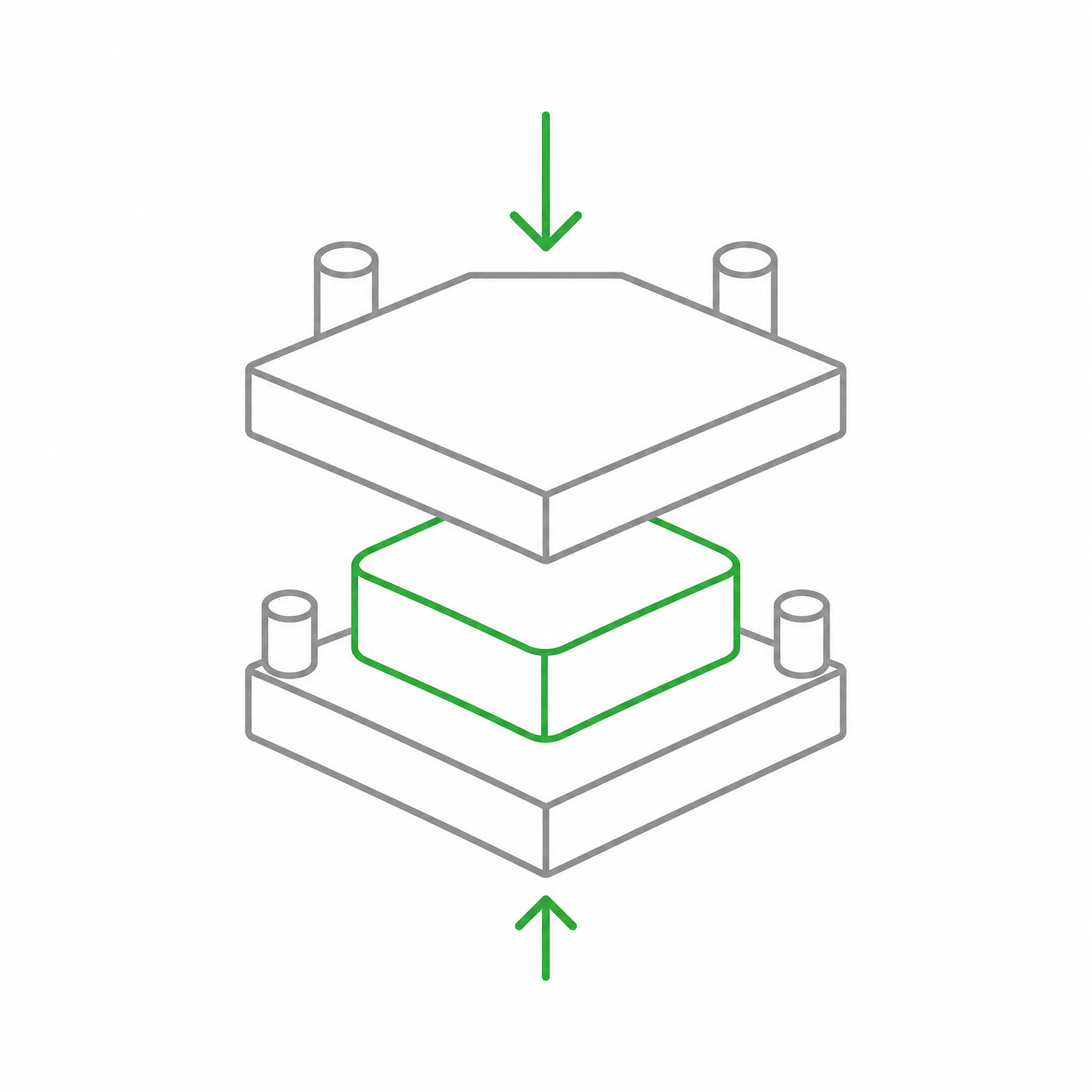 Compression Molding
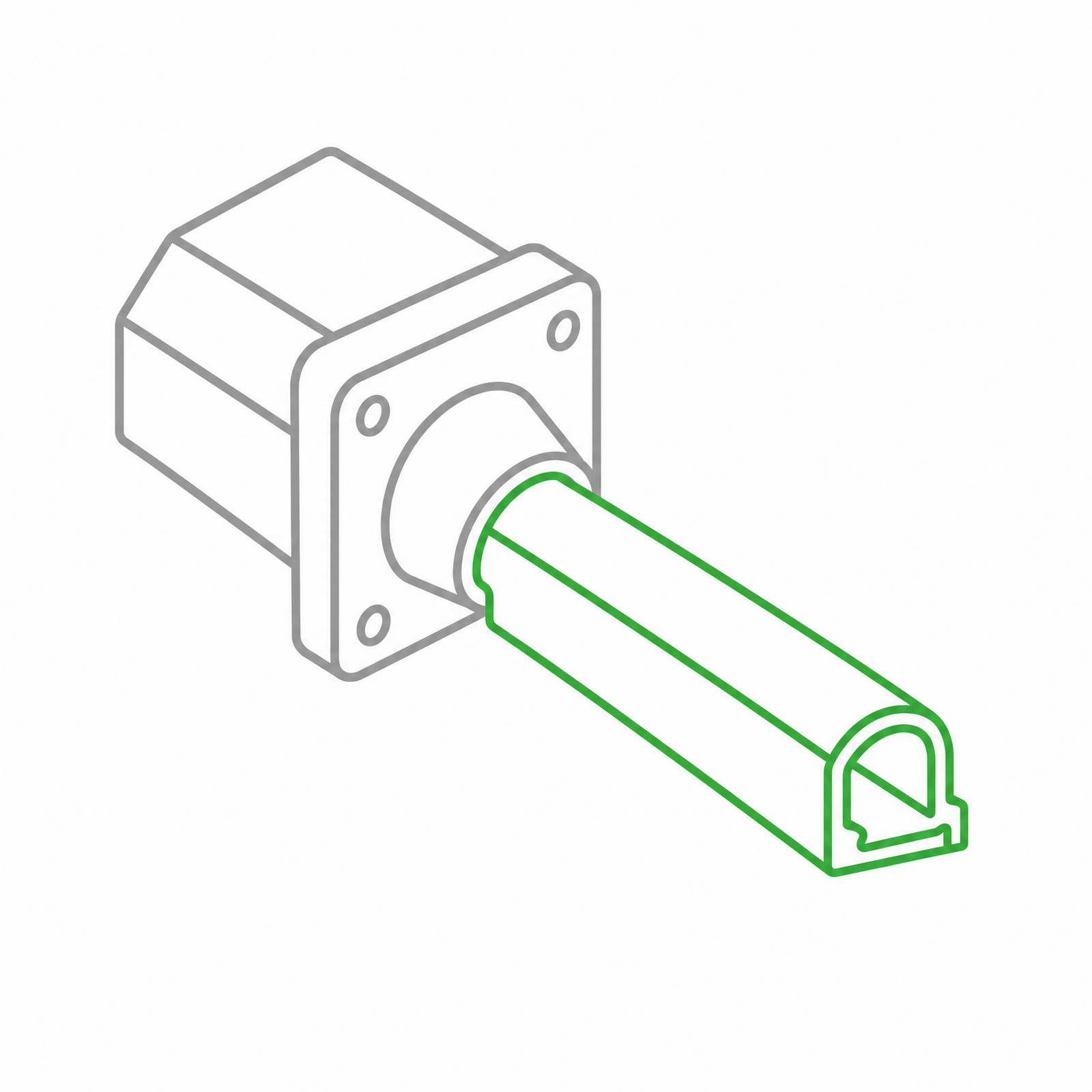 Silicone Rubber Extrusion
 In-house Tooling