
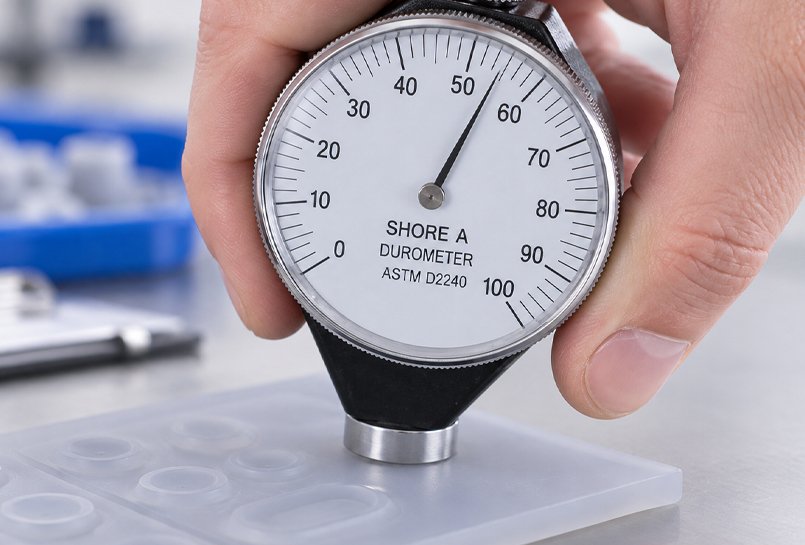
Silicone Shore A hardness describes how resistant cured silicone rubber is to indentation under a defined durometer test. It is one of the first values engineers and buyers notice on a silicone material data sheet, but it is also one of the easiest values to use without enough context.
A low number indicates a softer silicone. A high number indicates a harder silicone on the same Shore scale. That does not mean a Shore A 30 part will always feel softer than a Shore A 50 part in use. Wall thickness, shape, installed compression, contact area, hollow sections and reinforcement can change the response of the finished component.
The useful question is therefore not simply, “What silicone Shore hardness should I choose?” It is, “What combination of material hardness and part geometry will produce the required force, sealing, flexibility or support in the actual assembly?”
This guide explains how silicone Shore hardness is measured, how the common scales differ, what typical hardness ranges mean and how to write a more reliable silicone part specification.
What Is Silicone Shore Hardness?
Hardness is a material’s resistance to localized indentation. In a Shore durometer test, a spring-loaded indenter is pressed against the specimen under specified conditions. The instrument converts the indentation depth into a value from 0 to 100 on the selected scale.
The higher the reading, the less deeply the indenter penetrates. The lower the reading, the more the material yields under the test load.
Shore hardness is an empirical quality-control measurement. It is influenced by the indenter geometry, spring force, contact time, sample thickness, temperature and viscoelastic behavior of the rubber. ASTM explains that indentation hardness is inversely related to penetration and that no simple relationship exists between results from different durometer types. See the official scope of ASTM D2240.
This leads to three practical rules:
- A hardness number is incomplete without its scale, such as 40 Shore A.
- Values from different Shore scales should not be treated as directly interchangeable.
- Shore hardness should not be used as a substitute for tensile modulus, compression force, tear strength or finished-part functional testing.
For example, two silicone compounds can both measure 50 Shore A while producing different tensile, tear, compression-set or rebound behavior. Their cured parts may therefore perform differently even when the hardness certificate shows the same nominal value.
Shore A, Shore OO and Shore D for Silicone
Several durometer scales exist because one indenter and spring combination cannot measure gels, soft elastomers and rigid plastics equally well.
Shore A
Shore A is the most common scale for solid silicone rubber parts in the normal elastomer hardness range. It is widely used for molded seals, gaskets, keypads, valves, grips, rollers, bumpers and other flexible components.
Many commercial solid silicone and liquid silicone rubber grades fall somewhere around 10 to 80 Shore A, with selected formulations extending below or above that range. This is a broad market observation, not a universal limit.
Shore OO and ISO Shore AO
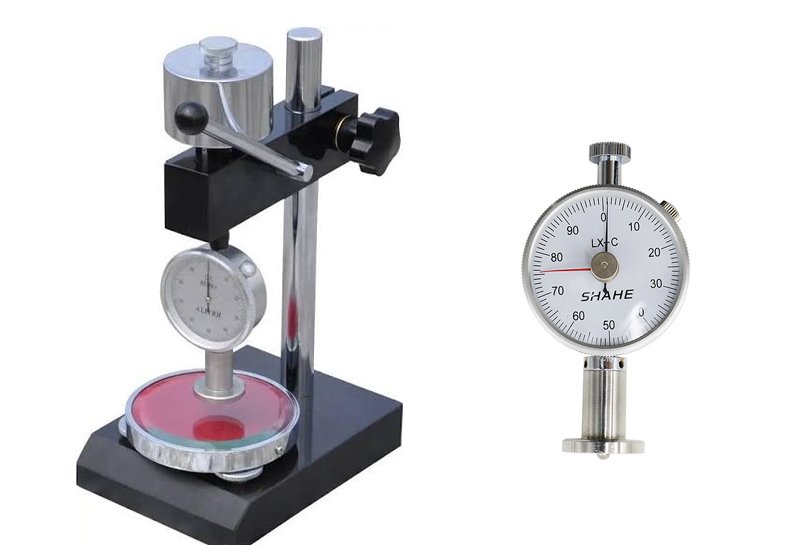
Very soft silicone gels, gel-like elastomers and cellular materials can sit below the useful range of a normal Shore A instrument. ASTM D2240 includes softer scales such as Shore OO, while ISO 48-4 includes the Shore AO scale for low-hardness and cellular rubber.
These scales use different test conditions. A Shore OO value must not be presented as though it were a Shore A value. When a product is described only as “20-degree silicone,” the specification is ambiguous until the scale is confirmed.
Shore D
Shore D is intended for high-hardness rubber and harder polymeric materials. It may be relevant to unusually hard silicone compounds or rigid adjacent materials, but most flexible silicone products are specified on Shore A or a softer scale.
Approximate conversion charts between Shore scales can help with early comparison, but they should not be used as acceptance criteria. The correct approach is to test the actual material with the specified durometer scale.
Typical Silicone Shore Hardness Ranges
The following ranges provide a practical starting point for discussing solid silicone parts. They are not fixed design rules, and the exact material grade may have a narrower available hardness range.
| Silicone Shore hardness | General feel | Typical design direction | Points to review |
|---|---|---|---|
| Below 10 Shore A or softer scale | Gel-like or extremely soft | Conformal pads, cushioning surfaces and very soft contact interfaces | Tack, handling, tear risk, dimensional stability and whether Shore A is the correct scale |
| 10-30 Shore A | Soft and highly compliant | Soft seals, wearable contact parts, baby-care components, diaphragms and light cushioning | Thin-wall tearing, flash, assembly deformation and compression set |
| 30-50 Shore A | Soft to medium | General seals, gaskets, medical components, keypads, flexible covers and vibration-control parts | Sealing force, tactile response, rebound and tolerance stack-up |
| 50-70 Shore A | Medium to firm | Industrial gaskets, rollers, support pads, connector seals and durable molded parts | Required compression load, insertion force, abrasion and mating-part stiffness |
| Above 70 Shore A | Firm | Hard rollers, high-load pads and parts requiring stronger dimensional support | Reduced conformity, higher assembly force and whether another material family is more suitable |
These descriptions refer to material feel under comparable conditions. A thin 70 Shore A lip can flex more easily than a thick 30 Shore A block. Geometry often has a larger effect on finished-part force than a small change in compound hardness.
What Hardness Changes in a Silicone Part
Increasing silicone Shore hardness generally increases resistance to indentation and can provide more support under load. It may also increase insertion force, closing force or the pressure required to compress a sealing feature.
Reducing hardness generally improves conformity to surface variation and makes a part easier to deform. However, an extremely soft material can be harder to demold, trim, measure and assemble. It may stretch under its own weight, attract contamination if the formulation is tacky or tear around thin features.
Hardness should therefore be balanced with mechanical and other properties like tensile strength and elongation, tear resistance,compression set and stress relaxation, operating temperature and fluid exposure, dimensions and tolerance.
How Silicone Shore Hardness Is Tested
Two widely referenced methods are ASTM D2240-15(2021) and ISO 48-4:2018. ISO states that Shore A is used for rubber in the normal hardness range, Shore D for the high-hardness range, Shore AO for low-hardness and cellular rubber, and Shore AM for thin specimens in the normal range.
The basic test sequence is straightforward:
- Condition and support a suitable specimen.
- Place it on a flat, stable surface.
- Hold the durometer perpendicular to the test surface.
- Bring the presser foot into full contact without impact.
- Record the reading at the time required by the chosen standard or specification.
- Repeat at properly spaced locations and report the result using the agreed method.
The result can still change when the setup changes. The following variables should be controlled.
Specimen Thickness and Layering
A specimen that is too thin allows the support surface to influence the result, often making the material appear harder. A standard plaque is therefore preferable when the finished part does not provide a sufficiently large and flat test area.
Some methods permit layers to be stacked under defined conditions, but stacked sheets can behave differently from a single molded specimen. The drawing or inspection plan should state whether hardness is measured on a standard test plaque, a finished part or an agreed witness sample.
Surface Shape and Test Location
Curved, textured, narrow or irregular surfaces can prevent the durometer foot from sitting flat. Testing near an edge, parting line, rib, internal insert or local thickness transition can also change the reading.
For small silicone components, the nominal compound hardness may therefore be certified using a standard plaque, while the finished part is controlled through dimensions and a functional force test.
Temperature, Conditioning and Reading Time
Silicone is viscoelastic, so temperature and time affect the reading. A value taken immediately after contact may differ from a value held for a longer dwell. A warm part taken directly from post-curing may also produce a different result from a conditioned specimen.
Do not combine test conditions from different standards. State the standard edition, conditioning requirements, reading time and any customer-specific deviations in the inspection plan.
Instrument, Operator and Calibration
The durometer type must match the selected scale and should be verified or calibrated according to the applicable quality procedure. A controlled stand can reduce variation in application speed and alignment compared with inconsistent hand-held measurement.
Operator technique still matters. Tilting the instrument, pressing too quickly, retesting the same location or measuring too close to an edge can produce misleading results.
Choosing Silicone Shore Hardness by Function
The best starting value comes from the function of the finished part, not from a generic industry chart.
Seals and Gaskets
A soft gasket can conform to flange variation at lower clamping force. A harder gasket can provide more support and resist excessive extrusion, but it may require greater compression force and better flange flatness.
Define available clamp load, sealing width, gap, pressure, fluid, temperature and expected compression before selecting hardness.
Keypads and Buttons
Hardness affects the feel of a silicone keypad, but web geometry, travel, contact design and wall thickness usually have a stronger influence on actuation force and tactile response. Specify force-travel targets alongside compound hardness rather than asking hardness to control the entire feel.
Valves and Diaphragms
Soft silicone can support low opening force and responsive movement, while harder material can increase closing force or dimensional support. Slit geometry, membrane thickness, pre-load and pressure direction should be developed together with hardness.
For thin functional membranes, tear strength and fatigue testing can be more important than moving from one nearby Shore A grade to another.
Rollers and Vibration Components
Roller hardness affects contact area, nip response, load support and surface conformity. Pads and vibration isolators also depend on shape factor, installed compression, supported mass and excitation frequency.
For these products, a material hardness target should be accompanied by load-deflection, runout, rebound, damping or durability requirements appropriate to the assembly.
Medical and Food-Contact Parts
Hardness is only one part of material selection for regulated products. Confirm the exact grade, intended contact, biological or food-contact documentation, sterilization or cleaning method, extractables requirements and production controls.
A softer grade is not automatically safer or more comfortable. Finished geometry, surface condition, contact pressure and duration must be evaluated on the actual device or product.
How to Specify Silicone Shore Hardness
A purchase order that says only “silicone, hardness 50” leaves several questions unanswered. A stronger drawing note or material specification should identify:
- Material family and exact approved grade, where required
- Hardness value and scale, such as 50 Shore A
- Permitted tolerance, based on supplier capability and product risk
- Test standard and edition
- Test specimen or approved measurement location
- Conditioning temperature and time when relevant
- Reading time and reporting method
- Whether the requirement applies before or after post-curing
- Whether aging, heat, fluid exposure or sterilization requires a hardness-change limit
A commonly quoted hardness tolerance should not be inserted automatically into every drawing. Compound manufacturing variation, pigment, cure state, post-curing, specimen geometry and test reproducibility all affect what is realistic. Discuss the tolerance with the material supplier and molder before tooling approval.
Hardness should also be separated from color and formulation control. Two batches can meet the same Shore A range but differ in other properties if they use different base polymers, fillers or cure systems. Where performance and regulatory documentation matter, approve the compound grade rather than accepting any silicone that reaches the target hardness.
Conclusion
Silicone Shore hardness is useful because it provides a fast, repeatable way to compare indentation resistance when the scale and test conditions are controlled. It helps confirm incoming material, monitor molding consistency and communicate a general softness range.
It does not fully predict sealing force, flexibility, fatigue life, tactile feel or load-bearing behavior. Those outcomes come from the interaction between material properties, component geometry and the assembled product.
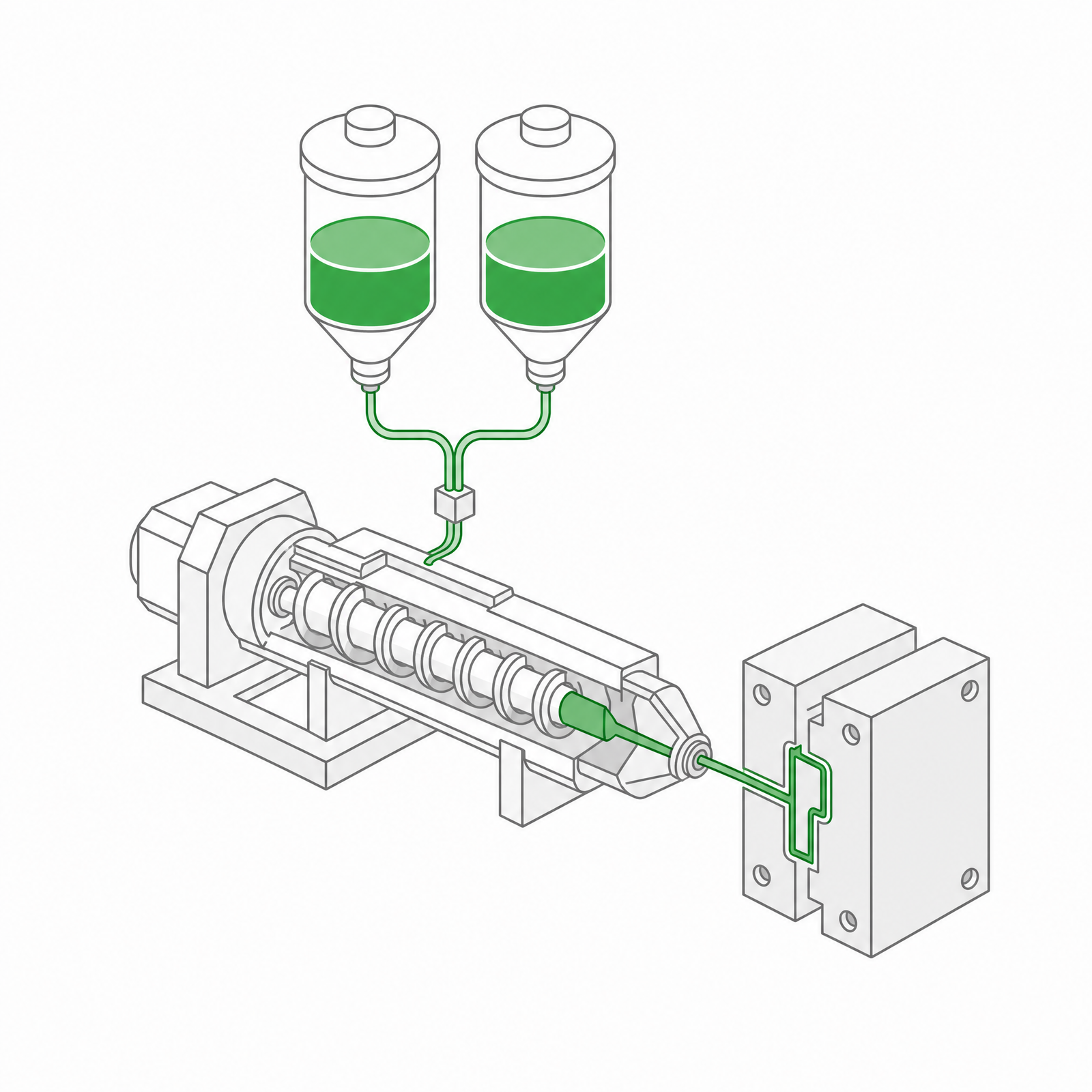
For a new custom part, begin with the functional requirement. Select a candidate silicone Shore hardness, develop the geometry around the available load and space, then verify the molded component with dimensional and functional testing. Fecision supports material review, LSR injection molding and compression molding for custom silicone parts that need a defined hardness and repeatable production performance.
 LSR Injection Molding
 Silicone Rubber Overmolding
 Compression Molding
 Silicone Rubber Extrusion
 In-house Tooling